
Instructions for Authors
INSTRUCTIONS FOR AUTHORS
STEP-BY-STEP SUBMISSION GUIDE
authors
instructions
to the authors
and type of
manuscripts
template
PT/EN
the form
the checklist
OJS
Manuscript submission to the journal must be made through the Open Journal Systems (OJS) platform, with the complete manuscript, tables, charts, figures, and images (in color or black and white), along with the submission form (SUBMISSION FORM and Copyright and AI Use Form) and the checklist, both completed by the corresponding author.
All authors must be registered on the OJS platform by the corresponding author.
Manuscripts submitted to the Revista de Pediatria SOPERJ must be sent in Portuguese and in English. Authors who need support with translation (Ana Silvia Gesteira: asilviagesteira@hotmail.com) or with the structuring or review of references (Kátia de Oliveira Simões: katia.simoes@gmail.com e Kesya Cristina Silva de Paula: kesyacristina.s.p@gmail.com), if they wish, may consult the professionals recommended by the Journal. Any resulting costs will be the authors' responsibility.
The abstracts must be submitted in Portuguese, English and Spanish.
The Journal does not charge any fee for the manuscript submission and publication process.
If an article has been rejected, it may be resubmitted after a minimum interval of two months, and the number previously generated by the system for that article must be reported. The references must be up to date, and the author must include a cover letter to the Editor specifying the changes made that justify the resubmission.
Manuscript Preparation
The word processor used must be Microsoft Word, with 3 cm margins on both sides, on A4 paper, Times New Roman font, size 12, and 1.5 line spacing throughout all sections. No footnotes are accepted.
The manuscript must be written in the third person singular, with verbs in the active voice.
It is recommended that the structure of manuscripts follow the scientific writing guidelines appropriate to the study design (EQUATOR Network).
Manuscripts accepted for publication may be modified to conform to the Journal's editorial and graphic style, without, however, altering any of their technical-scientific content. In such cases, the authors will be informed in advance of the changes made.
Main Guidelines for Each Section
- Title page
TITLE
(PORTUGUESE, ENGLISH AND SPANISH) Times New Roman 12 (up to 15 words)
Authorship
Full name of the authors. Each author's affiliation must include the following information: university, city, country, and ORCID (all authors must have an ORCID identifier –Open Researcher and Contributor ID – https://orcid.org/signin);
Corresponding author
Name, complete address with postal code, telephone number, and e-mail of the author responsible for correspondence about the manuscript.
Manuscript type
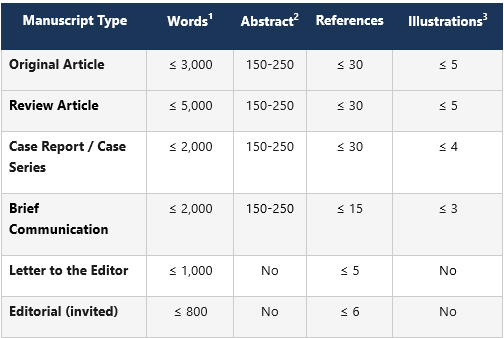
1 Word count of the main text, excluding the abstract, bibliographic references, figure legends, and table contents.
2 single paragraphs, in Portuguese, English, and Spanish; structured into introduction, objective, method, results and conclusion, except for Case Report/Case Series: introduction, case description (results) and conclusion.
3 each illustration must occupy one page.
Funding and Acknowledgments (SUBMISSION FORM and Copyright and AI Use Form)
Report the funding institution. The authors must declare all sources of funding or support, public or private, for conducting the research (including funding agencies), in compliance with Capes Ordinance No. 206, of September 4, 2018, which establishes the obligation to cite Capes.
The name of the company and the origin (city, state, and country) that provided the material, supplies, or equipment, free of charge or at a discount, must also be indicated. If there was no funding, the authors must state that the research received no funding.
Acknowledgments are optional for participants not considered authors.
Data Availability Statement (SUBMISSION FORM and Copyright and AI Use Form)
Conflict of Interest Statement (SUBMISSION FORM and Copyright and AI Use Form)
It is the authors' responsibility to declare any possible conflicts of interest, including political or financial interests associated with patents or property, or the provision of materials, supplies, or equipment used in the study.
Authorship criteria (author contributions)
The corresponding author, responsible for the manuscript submission, must complete the form (SUBMISSION FORM and Copyright and AI Use Form), specifying each author's individual contribution to the preparation of the manuscript, in accordance with the criteria established by the International Committee of Medical Journal Editors (ICMJE).
- Abstract and Keywords (descriptors)
ABSTRACT (Portuguese, English, and Spanish - except for letters to the editor).
It must contain a minimum of 150 and a maximum of 250 words, accompanied by keywords (three to five), as well as their English keywords and Spanish palabras clave, presented in single spacing. They must be structured into introduction, objective, method, results, and conclusion. Abstracts for Case Reports/Case Series follow this structure: introduction, case description (results), and conclusion.
Keywords: must be entered immediately below the abstract (3 to 5). In Portuguese and Spanish, they must be drawn from DeCS (http://decs.bvs.br) and in English, from MeSH: (http://www.ncbi.nlm.nih.gov/mesh). Descriptors must be separated by semicolons, with initial capital letters.
- Introduction
The theoretical framework and the reasons for conducting the research must be described objectively and clearly. Cite current and relevant references. It must state the study's objective(s).
- Method
It must be clearly described how and why the study was conducted. The level of detail must allow the reader to reproduce the research performed. The method includes a description of the design, selection of study subjects, inclusion and exclusion criteria, target population, data collection techniques, variables collected, and data analysis and interpretation.
In quantitative studies, the statistical methods must be described in sufficient detail for the reader to assess their appropriateness and verify the results. Define statistical terms, abbreviations, and symbols. If a statistical software package was used, specify the version used.
In qualitative studies, detail the theory, sources of information, research subjects (when applicable), and the techniques used for data collection, synthesis, and analysis.
In studies involving human subjects, indicate whether the procedures adopted complied with the ethical standards of the Research Ethics Committee (CEP) of the institution that approved the research, with the Declaration of Helsinki and with Resolutions No. 466/2012 and 510/2016 of the National Health Council. Do not use patients' names, initials, or record numbers, especially in illustrative material.
In the case of experiments involving animals, indicate whether the standards of the institutions, National Research Councils, or any applicable national law on the use and care of laboratory animals were followed.
Every systematic review must have its protocol published or registered in a systematic review registry database, such as PROSPERO.
When submitting manuscripts, it is mandatory to include a statement that the research was approved by, or exempted from submission to, the Research Ethics Committee (CEP). The CEP approval number must be reported.
The Revista de Pediatria SOPERJ follows the Recommendations for the Conduct, Reporting, Editing, and Publication of Scholarly Work, issued by the International Committee of Medical Journal Editors (ICMJE), as well as the code of conduct and guidelines for editors and reviewers of the Committee on Publication Ethics (COPE).
- Results
Present the main or most important results first, according to the study's objective. Describe only the results found, without including interpretations or comparisons. Provide information regarding the primary and secondary outcomes identified in the methods section.
Present the results, tables, and illustrations in a logical sequence, ensuring that the text complements, rather than repeats, what is described in them. Restrict tables and illustrations to those necessary to explain and support the article's argument.
Avoid the non-technical use of statistical terms, such as: “random” (which implies a source of randomization), “normal,” “significant,” “correlation,” and “sample.” Define statistical terms, abbreviations, and symbols.
It is recommended that authors share, in recognized repositories, the primary data, codes, and other materials underlying the submitted article.
- Discussion
It must contain the authors' interpretation, compare the results with the literature, relate the observations to other relevant studies, point out the study's limitations, emphasize new and important aspects of the study and the conclusions derived from it, including suggestions for future research. Do not repeat, in detail, data or other material already presented in the “introduction” or “results” sections. The discussion may be written together with the results, if that is the author's preference, only in qualitative studies.
- Conclusion
It must be based on the results found and linked to the study's objectives.
Unqualified statements and conclusions not fully supported by the data must be avoided. No citations of references, charts, tables, or figures should be made.
- References
In the body of the article:
Number in the text using superscript Arabic numerals (e.g., The extent of survival, among others¹), consecutively, according to the order in which they are first mentioned in the text, without mentioning the authors. The same rule applies to tables and legends.
Sequential citations must be separated by a hyphen (e.g.:3-7). If interspersed, they must be separated by a comma (e.g.:1,4,6,9). Sequences with only two citations must be separated by a comma (e.g.:3,4).
References must be checked against the original documents. Indirect citations should be avoided, but, if necessary, the term “apud” should be used.
The use of software such as Mendeley (a reference manager) is recommended for organizing and standardizing references, in accordance with the Journal's standards. The use of common generative artificial intelligence tools in this process is not recommended, due to the possibility of errors.
In the reference list:
References must follow the standards summarized in the original English-language ICMJE document entitled Recommendations for the Conduct, Reporting, Editing and Publication of Scholarly Work in Medical Journals: Sample References or the standards presented in full in the publication Citing Medicine 2nd Edition (known as the 'Vancouver Style').
Include the name of up to six authors in the order in which they appear in the publication, starting with the surname, followed by all initials of the given names, separating each author with a comma. In the case of a publication with more than six authors, the first six are cited, separated by commas, followed by the expression "et al." When the author's surname includes a generational suffix – Filho, Sobrinho, Júnior, Neto –, it must be placed after the last surname: João dos Santos de Almeida Filho = Almeida Filho JS, José Rodrigues Júnior = Rodrigues Júnior J.
Titles must be written with the first letter capitalized and subsequent letters in lowercase. Exceptions are proper names, names of sciences or disciplines, educational institutions, countries, cities or other places, and names of public or private entities.
For journal titles, use as a guide the LocatorPlus, a reference source of the National Library of Medicine, which provides, under the Journal Title option, the title and/or abbreviation used.
All references must be accompanied by their respective Digital Object Identifiers (DOIs).
Examples of references according to type:
|
Reference type |
Example (Vancouver format) |
|
Journal article (up to 6 authors) |
Agostini FSA, Saraiva FP, Passos AF, Amador RC, Conci LS. Use of compressive suture in the prevention and management of perioperative complications of glaucoma |
|
Article with more than 6 authors |
Raposo JC, Cipriano JSM, Santos ATD, Godoy GJP, Colares V, Caraciolo MDM, et al. Association between adolescents who are victims of bullying and weapon possession. J Pediatr (Rio J). 2023;99(4):310-8. |
|
Article with pagination and DOI |
Pereira LM, Souza RT. Manifestações cutâneas em imunodeficiências primárias. J Pediatr (Rio J) [Internet]. 2024 [citado 2026 jun 18];100(3):215-22. doi: 10.1016/j.jped.2024.03.012. |
|
Article with electronic location identifier and DOI |
Viana TSN, Santos CAS. Perfil epidemiológico de casos prováveis de dengue na faixa etária pediátrica no Brasil de 2018 a 2024. Rev Pediatr SOPERJ [Internet]. 2026 [citado 2026 jun 18];26(2):e20260386. doi:10.31365/issn.2595-1769.2026.0386. |
|
Book |
Bricks LF, Berezin EN, editors. Infectious diseases in pediatrics. 3rd ed. São Paulo: Atheneu; 2022. |
|
Book chapter |
Carvalho LM. Primary immunodeficiencies. In: Lopez FA, Campos Júnior D, editors. Tratado de pediatria: Sociedade Brasileira de Pediatria. 5th ed. Barueri: Manole; 2021. p. 1123-35. |
|
Thesis/dissertation |
Andrade PS. Immunological evaluation in children with recurrent infections [thesis]. Rio de Janeiro: Universidade Federal do Rio de Janeiro; 2020. |
|
Website/electronic document |
Organização Mundial da Saúde. COVID-19 dashboard [Internet]. Geneva: WHO; 2022 [cited 2025 nov. 10]. Disponível em: https://covid19.who.int (Add DOI if it's available) |
|
Article "ahead of print" |
Reis BCS. Genética médica na prática pediátrica: conceitos essenciais. Rev Pediatr SOPERJ. 2026. In press. |
Many academic databases, such as PubMed, Scopus, and Web of Science, offer automatic citation tools. After locating and clicking on the article, look for the “cite” icon and select the desired citation style. Copy only the authors' names, the article title, the journal name, the year (excluding day and month), the volume/issue/pages (e-location, if applicable), and the DOI.
|
How it appears under “cite” in the databases |
How to cite it in the reference list |
|
Glaser MA, Hughes LM, Jnah A, Newberry D. Neonatal Sepsis: A Review of Pathophysiology and Current Management Strategies. Adv Neonatal Care. 2021 Feb 1;21(1):49-60. doi: 10.1097/ANC.0000000000000769. PMID: 32956076. |
Glaser MA, Hughes LM, Jnah A, Newberry D. Neonatal Sepsis: A Review of Pathophysiology and Current Management Strategies. Adv Neonatal Care. [Internet]. 2021 [cited 2026 Ago 12];21(1):49-60. doi: 10.1097/ANC.0000000000000769 |
9. Illustrations
Illustrations (figures, charts, tables, graphs, etc., in black and white or color) must be inserted in the text with complete titles, source information, legends, and additional notes, when necessary. Do not place titles and explanations on the illustrations themselves, but rather in the legends
They must be numbered according to the order in which they were cited in the text.
Photographs must be provided as follows: digital file in TIFF, JPG, or EPS format, with a minimum resolution of 300 dpi for standard photographs and 600 dpi for photographs containing fine lines, arrows, legends, etc.
Graphs, drawings, tables, and charts must be submitted as Word, Excel, or PowerPoint files in editable format (open file). For drawings and graphs, the minimum resolution is 1,200 dpi.
If photographs of people are used, the subjects must not be identifiable, or their photographs must be accompanied by written consent for publication.
If an illustration has already been published, cite the original source and submit the copyright holder's written authorization to reproduce the material. Authorization is required from either the author or the publisher, except for public-domain documents.
The use of platforms such as Mind the Graph and BioRender may be used to create graphics, infographics, flowcharts, and diagrams that illustrate the article's content. The use of generative AI, such as ChatGPT and Gemini, for generating or modifying any content is prohibited at this time.
10. Tables
Tables are used to display information concisely and in an easy-to-read format. Including data or information in tables, rather than describing it in the text, aims to reduce the length of the text.
Define a short or abbreviated heading for each column. Place explanations in table footnotes, not in the header. Explain, in footnotes, all non-standard abbreviations used in each table. Use symbols to explain information (letters of the alphabet or symbols such as *, §, †, ‡).
Each piece of data in the table must be entered in a separate cell, divided into rows and columns. If the content of one cell refers to more than one entry in another column, the “merge cells” feature should be used for that cell.
Identify statistical measures of variation, such as standard deviation and standard error of the mean.
Check whether the absolute and relative values presented are consistent with each other and with what is described in the text.
- Nomenclature
The rules of biomedical nomenclature, as well as the abbreviations and conventions adopted in specialized disciplines, must be strictly observed.
It is also recommended to avoid the use of unusual abbreviations or acronyms. Abbreviations or acronyms should only be used when well established in the literature, in order to preserve the clarity of the manuscript.
Examples of well-established abbreviations: SUS, PAHO, WHO
Manuscripts written in Portuguese must comply with the New Orthographic Agreement of the Portuguese Language.
Technical Requirements for Manuscript Submission
Before submitting the manuscript, check whether the “Instructions for Authors” and the items below have been met:
- Submit the complete manuscript file in Microsoft Word.
- Article: Portuguese and English; abstract/keywords: Portuguese, English, and Spanish.
- Use 1.5 line spacing throughout the document.
- Review the sequence: title page; abstracts and keywords (3 to 5, with their respective Keywords and Palabras clave) and the structure (sections) of the article.
- Tables, charts, and figures (with legends) must be inserted and cited throughout the text, not at the end of the document as attachments.
- References must be numbered, in superscript, in the order they appear in the text, and correctly typed. Check that all works cited are in the reference list and that all references listed are cited in the text.
- Submission Form and Copyright Statement completed and signed only by the author responsible for the submission (SUBMISSION FORM and Copyright and AI Use Form).
- Add permission to reproduce previously published material or to use illustrations that could identify individuals.
- Complete the checklist.
- Article Template.