CASE
REPORT
DOI: http://dx.doi.org/10.31365/issn.2595-1769.2026.0411
Neonatal arterial thrombosis associated
with maternal paraganglioma: a case report
Trombose arterial neonatal associada a paraganglioma materno:
relato de caso
Trombosis arterial neonatal asociada a paraganglioma materno:
reporte de un caso
Gabriela Vieira Bon1
Thaís Petri Felix2
Vivian Nunes Kern Pessôa3
Daniel Alves Bulzico4
Giovanna Aparecida
Balarini Lima5
Giselle Fernandes Taboada6
1.Faculdade de
Medicina, Universidade Federal Fluminense, Niterói-RJ, Brazil. ORCID: https://orcid.org/0009-0000-9404-1839
2.Endocrinologia,
Centro Universitário Multivix, Vitória-ES, Brazil. ORCID: https://orcid.org/0000-0003-2703-8757
3.Serviço de
Endocrinologia, Hospital Universitário Antônio Pedro, Universidade Federal
Fluminense, Niterói-RJ, Brazil. ORCID: https://orcid.org/0000-0002-8894-4393
4.Serviço de Medicina
Nuclear e Área de Endocrinologia Oncológica, Instituto Nacional de Câncer
(INCA), Rio de Janeiro-RJ, Brazil. ORCID: https://orcid.org/0000-0003-1270-7241.
5.Departamento de
Medicina Clínica, Faculdade de Medicina, Universidade Federal Fluminense,
Niterói-RJ, Brazil. ORCID:
https://orcid.org/0000-0002-1815-9373
6.Departamento de
Medicina Clínica, Faculdade de Medicina, Universidade Federal Fluminense,
Niterói-RJ, Brazil. ORCID: https://orcid.org/0000-0002-7177-0446
Corresponding
author:
Gabriela
Vieira Bon
E-mail:
gabrielavieirabon@id.uff.br
Submitted:
25/03/2026
Approved:
03/05/2026
Abstract
Introduction:
Neonatal
arterial thrombosis is a rare but life-threatening condition, most often
associated with umbilical catheterization, congenital thrombophilia, or
perinatal complications. Maternal pheochromocytomas and paragangliomas (PPGLs)
are rare during pregnancy, and their impact on neonatal hemostasis remains
poorly understood. Objective: To describe a case of neonatal arterial
thrombosis associated with maternal PPGL and its implications for neonatal
care. Case description: We report a case of neonatal arterial thrombosis
associated with maternal paraganglioma. A female neonate was born at 37 weeks
via cesarean section to a 29-year-old woman with a 9.4 cm retroperitoneal
paraganglioma. The infant had normal Apgar scores (9/9) and birth weight of
2,922g. On admission to the neonatal intensive care unit, she exhibited pallor,
cyanosis, and decreased temperature of the left lower limb. Doppler ultrasound
revealed a thrombus extending from the common femoral artery to the superficial
femoral artery origin. Thrombophilia screening was negative. The mother
experienced severe postpartum hypertension requiring nitroprusside, suggesting
massive catecholamine release during delivery. The infant was treated with
intravenous heparin followed by subcutaneous enoxaparin. Follow-up Doppler
ultrasound at 20 days showed complete thrombus resolution and the infant was
discharged without complications. Discussion: Excessive maternal
catecholamine release during delivery may overwhelm placental metabolic
capacity, leading to fetal exposure and subsequent arterial thrombosis.
Pediatric healthcare providers should be aware of this potential risk, as early
recognition and prompt anticoagulation therapy can lead to favorable outcomes.
Keywords: Thrombosis; Newborn;
Paraganglioma; Catecholamines; Pregnancy; Anticoagulation.
Resumo
Introdução: A trombose
arterial neonatal é uma condição rara, porém potencialmente fatal,
frequentemente associada à cateterização umbilical, trombofilia congênita ou
complicações perinatais. Feocromocitomas e paragangliomas maternos são raros
durante a gravidez e seu impacto na hemostasia neonatal permanece pouco
compreendido. Objetivo: Descrever um caso de trombose arterial neonatal
associada a paraganglioma materno e suas implicações para o cuidado neonatal. Descrição
do caso: Recém-nascida do sexo feminino, nascida com 37 semanas de gestação
por cesariana, filha de uma mulher de 29 anos com um paraganglioma
retroperitoneal de 9,4 cm. A criança apresentou escores de Apgar normais (9/9)
e peso ao nascer adequado (2.922 g). Na admissão à unidade de terapia intensiva
neonatal, apresentou palidez, cianose e hipotermia no membro inferior esquerdo.
O ultrassom Doppler revelou um trombo estendendo-se da artéria femoral comum
até a origem da artéria femoral superficial. O rastreio de trombofilia foi
negativo. A mãe apresentou hipertensão pós-parto grave, necessitando de
nitroprussiato, o que sugere uma liberação maciça de catecolaminas durante a
cirurgia. A recém-nascida foi tratada com heparina intravenosa, seguida de
enoxaparina subcutânea, com resolução completa do trombo após 20 dias e alta
sem complicações. Discussão: A liberação excessiva de catecolaminas
maternas durante o parto pode sobrecarregar a capacidade metabólica da
placenta, levando à exposição fetal e subsequente trombose arterial. Os
profissionais de saúde pediátricos devem estar cientes desse risco potencial,
pois o reconhecimento precoce e a terapia anticoagulante imediata podem levar a
desfechos favoráveis.
Palavras-Chave: Trombose;
Recém-nascido; Paraganglioma; Catecolaminas; Gravidez; Anticoagulação.
.
Resumen
Introducción La trombosis arterial neonatal es una
afección rara pero potencialmente mortal, frecuentemente asociada con la
cateterización umbilical, trombofilia congénita o complicaciones perinatales.
Los feocromocitomas y paragangliomas maternos son raros durante el embarazo, y
su impacto en la hemostasia neonatal aún no se comprende completamente. Objetivo:
Describir un caso de trombosis arterial neonatal asociada con un paraganglioma
materno y sus implicaciones para la atención neonatal. Descripción del caso:
Una recién nacida, nacida a las 37 semanas de gestación por cesárea, era hija
de una mujer de 29 años con un paraganglioma retroperitoneal de 9,4 cm. La niña
presentó puntuaciones de Apgar normales (9/9) y un peso al nacer adecuado (2922
g). Al ingresar a la unidad de cuidados intensivos neonatales, presentó
palidez, cianosis e hipotermia en la extremidad inferior izquierda. La
ecografía Doppler reveló un trombo que se extendía desde la arteria femoral
común hasta el origen de la arteria femoral superficial. El cribado de
trombofilia fue negativo. La madre presentó hipertensión posparto grave, que
requirió nitroprusiato, lo que sugiere una liberación masiva de catecolaminas
durante la cirugía. El recién nacido fue tratado con heparina intravenosa,
seguida de enoxaparina subcutánea, con resolución completa del trombo a los 20
días y alta sin complicaciones. Discusión: La liberación excesiva de
catecolaminas maternas durante el parto puede sobrepasar la capacidad
metabólica de la placenta, lo que conlleva la exposición fetal y la
consiguiente trombosis arterial. Los profesionales de la salud pediátrica deben
estar al tanto de este riesgo potencial, ya que el reconocimiento precoz y la
terapia anticoagulante inmediata pueden conducir a resultados favorables.
Palabras
Clave: Trombosis; Recién nacido; Paraganglioma;
Catecolaminas; Embarazo; Anticoagulación.
Neonatal
thrombotic events are rare but potentially serious complications that can
result in significant morbidity when not recognized and treated early. The
incidence of neonatal thrombosis ranges from 0.7 to 0.14 per 10,000 live
births,1 with arterial thrombosis being less frequent than venous
thrombosis.2,3
Risk
factors for neonatal thrombosis include the presence of venous or arterial
catheters, prematurity, maternal diabetes and hypertension, perinatal asphyxia,
congenital heart disease, and other conditions affecting fetal circulation.1,4
However, episodes of arterial thrombosis can also occur in the absence of these
traditional triggers, suggesting the involvement of additional perinatal
mechanisms possibly associated with endothelial dysfunction and the
particularities of the neonatal hemostatic system.5
In
addition to the maternal conditions mentioned, some others can impact fetal
circulation. Although they are rare tumors, pheochromocytomas and
paragangliomas sometimes occur in the obstetric population, posing challenges
in the management of the maternal-fetal dyad. These catecholamine-secreting
neuroendocrine tumors have an estimated incidence of between 1 in 15,000 and
54,000 pregnancies and may have significant implications for neonatal health
and well-being.6,7 Although maternal catecholamines typically do not
cross the placental barrier, extreme elevations -during paroxysmal episodes or
at delivery - can exceed placental metabolic capacity. Under these
circumstances, fetal exposure to high concentrations of these vasoactive
substances can result in growth restriction, premature birth, and, in rare
cases, cardiovascular complications.8,9
This
report describes a case of femoral artery thrombosis in a newborn girl whose
mother had an uncontrolled retroperitoneal paraganglioma, discussing possible
pathophysiological mechanisms and implications for neonatal management.
The case
report was approved by the Research Ethics Committee on 08/11/2024 (CAAE
83447324.0.0000.5243), and the Informed Consent Form was obtained from the
patient and legal guardian of the newborn.
CASE REPORT
A female
newborn (NB), born at 37 weeks of gestation via elective cesarean section, was
the daughter of a 29-year-old woman with a prior diagnosis of left
retroperitoneal paraganglioma. At birth, she had an Apgar score of 9/9 and
weighed 2,922 grams, appropriate for her gestational age. She was admitted to
the neonatal intensive care unit for observation due to her mother’s condition.
The mother
had been diagnosed with a left retroperitoneal paraganglioma measuring 9.4 x
5.9 x 9.5 cm, confirmed by elevated urinary catecholamine levels (dopamine:
1,192 µg/24h, reference value: < 500 µg/24h; metanephrines: 6,726 µg/24h,
reference value < 1,000 µg/24h; normetanephrines: 5,741 µg/24h, reference
value < 390 µg/24h). During the preoperative assessment for surgical removal
of the tumor, pregnancy was diagnosed, and considering this high-risk prenatal
context, surgery was postponed.
During
pregnancy, the patient presented with gestational diabetes mellitus, in
addition to episodes of paroxysms with sweating, tremors, and palpitations.
Treatment with NPH insulin and doxazosin was initiated to control blood glucose
and blood pressure, respectively. Doxazosin was titrated to a dose of 3 mg/day,
at which point the patient began to present with postural hypotension. The
pregnancy progressed to 37 weeks, when an elective cesarean section was
performed. In the postoperative period, she developed severe hypertension,
requiring sodium nitroprusside, probably due to massive release of
catecholamines by the tumor during the surgical procedure.
Upon
admission to the neonatal intensive care unit, the newborn presented with
pallor, cyanosis, and decreased temperature in the lower left limb. Physical
examination revealed an absence of peripheral pulses in the affected limb, with
a clear demarcation between the ischemic and well-perfused areas, raising
immediate suspicion of vascular compromise.
Doppler
ultrasound of the lower limbs showed a thrombus extending from the common
femoral artery to the origin of the superficial femoral artery. The
contralateral limb showed normal vascular flow. Additional images, including
computed tomography angiography of the carotid, vertebral, and cranial
arteries, showed no abnormalities, ruling out systemic thrombotic disease. In
addition, an investigation for thrombophilia was carried out, including
screening for antiphospholipid syndrome, antithrombin III deficiency, and
protein C and S deficiency. All results were negative, suggesting that the
thrombotic event was not due to a hereditary or acquired thrombophilic
condition.
After the
diagnosis, anticoagulation with intravenous unfractionated heparin was
initiated for five days, followed by subcutaneous enoxaparin at a dose of 1.7
mg/kg twice daily for 23 days. During hospitalization, the newborn presented
with mild and transient physiological jaundice, without associated hypoglycemia
or other complications. Throughout the treatment, she was regularly monitored
for signs of hemorrhagic complications and therapeutic response.
A
follow-up Doppler ultrasound performed 20 days after the initial diagnosis
confirmed complete resolution of the thrombosis, with restoration of arterial
flow, perfusion, color, temperature, and pulses in the affected limb.
Anticoagulation was discontinued, and the child was discharged from the
hospital in stable condition with a normal neurological examination. Long-term
follow-up plans included consultations with pediatric cardiology and vascular
surgery to monitor possible late repercussions of the thrombotic event.
DISCUSSION
To our
knowledge, this is the first case report of arterial thrombosis in a newborn
whose mother had paraganglioma. Although this is a complication described in
adult patients with pheochromocytoma and/or paraganglioma, due to chronic
excess of catecholamines, which results in endothelial dysfunction, platelet
activation and altered coagulation,10,11 the occurrence of this
phenomenon in the neonatal period is still poorly understood. Neonatal arterial
thrombosis in this context is possibly due to the interaction of multiple
pathophysiological mechanisms.
First, it
is worth highlighting the unique hemostatic system of neonates, which differs
from the adult system. Newborns have physiologically reduced levels of most
coagulation factors, especially those dependent on vitamin K (II, VII, IX and
X), as well as natural anticoagulants, such as protein C and S, antithrombin
and heparin cofactor II. These changes are counterbalanced by higher hematocrit
and von Willebrand factor levels, as well as larger red blood cells.1,5
However,
this balance has limited adaptive capacity. Once the coagulation cascade is
activated, even small amounts of tissue factor can generate thrombin more
rapidly in neonatal plasma. This occurs due to reduced concentrations of tissue
factor pathway inhibitor and antithrombin.1 Elevated von Willebrand
factor, particularly in ultra-high molecular weight multimers, promotes
platelet adhesion to damaged endothelium under high shear stress conditions
present in constricted arteries. Furthermore, the pro-inflammatory environment
associated with endothelial injury can further activate platelets through
pathways that differ from traditional agonist stimulation,5
predisposing the neonatal circulation to thrombus formation.
These
mechanisms can be interpreted within Virchow’s triad, in which catecholamine-induced
vasoconstriction, associated with endothelial injury and altered blood flow,
facilitates thrombus formation in a physiologically vulnerable neonatal
coagulation system.12
In
addition, the maternal condition should also be considered as a possible
contributing factor to arterial thrombosis in this child. Under normal
circumstances, maternal catecholamines rarely cross the placental barrier due
to efficient placental metabolism by catechol-O-methyltransferase and monoamine
oxidase.13,14 Still, given the absence of other explanations for the
newborn’s arterial thrombosis and considering the mother’s history of
paraganglioma, the possibility has been raised that, during labor, the marked
release of catecholamines may have exceeded the placental metabolization
capacity. This is, however, a speculative hypothesis, not directly described in
the literature, although it is a biologically plausible event. It should also
be considered that pheochromocytomas and paragangliomas in pregnancy are rare events,
and even more uncommon is their manifestation during labor, which limits the
availability of clinical data capable of consistently evaluating this type of
mechanism.
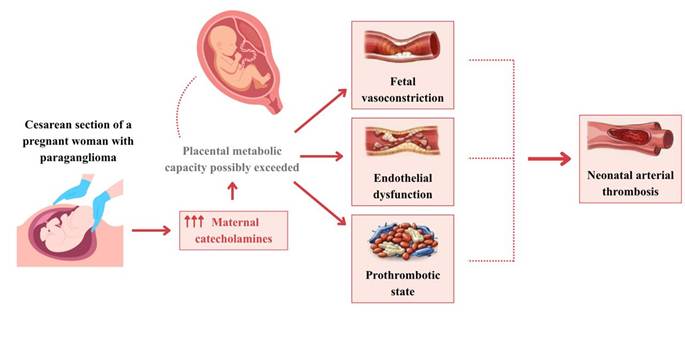
Severe
maternal hypertension in the postpartum period, which required nitroprusside in
this case, suggests a massive release of catecholamines during labor, the peak
of which may have exceeded placental metabolic capacity, resulting in fetal
exposure to elevated levels of norepinephrine and epinephrine. Prolonged
exposure to these vasoactive substances can cause severe vasoconstriction,
endothelial dysfunction, and activation of the coagulation cascade, ultimately
leading to thrombotic complications.6,8
In this
sense, this case presents important implications for neonatal care. Newborns of
mothers with known or suspected paraganglioma should undergo careful
cardiovascular evaluation, including assessment of peripheral perfusion and
pulse examination, and the presence of signs suggestive of vascular compromise
should raise suspicion of thrombotic complications. In these cases, Doppler
ultrasound should be performed early, as early detection and treatment can
prevent irreversible tissue damage.
Furthermore,
the successful management of neonatal arterial thrombosis in this report is
consistent with recent pediatric literature, which shows favorable outcomes
with early anticoagulant therapy. The use of unfractionated heparin followed by
low molecular weight heparin is a well-established approach in the management
of neonatal thrombosis.15
Despite
the suspicion of a causal relationship between excess maternal catecholamines
and neonatal arterial thrombosis in this case, definitive proof of causality is
limited by the inability to directly measure fetal exposure to catecholamines.
The absence of measurements of these substances in the newborn is a relevant
limitation, even though their usefulness would probably be reduced due to their
short half-life.7 Similarly, metanephrines (plasma or urinary) were
not measured, which are more indicated because they have greater sensitivity
for detecting catecholamine excess, since they more stably reflect its
production.4,7 Furthermore, although reference values for
metanephrines exist, their interpretation in the neonatal period requires
caution, due to the physiological variations of this phase and the influence of
perinatal stress.
Due to
these and other limitations, and because this is a single case report, it is
not possible to establish a causal relationship between maternal paraganglioma
and neonatal arterial thrombosis, nor can the contribution of unidentified
factors be excluded, including possible uninvestigated maternal or neonatal
prothrombotic conditions and other perinatal factors that may have influenced
the observed outcome.
Future
research should focus on understanding the mechanisms of catecholamine
transport and metabolism in the placenta in the context of maternal
paraganglioma. Long-term follow-up studies are also needed to determine whether
children exposed to excess maternal catecholamines in utero have an increased
risk of cardiovascular complications in adulthood.
In
conclusion, this report describes a case of neonatal arterial thrombosis
associated with maternal paraganglioma, a condition not yet documented in the
literature. The case reinforces the importance of clinical surveillance of
newborns exposed to catecholamine-secreting maternal tumors, as well as the
early recognition of signs of vascular compromise. Rapid diagnosis and
successful management with anticoagulant therapy resulted in complete
resolution of the thrombosis, without sequelae. These findings highlight the
need for a multidisciplinary approach, involving neonatologists, pediatric
cardiologists, and vascular surgeons, and suggest that fetal exposure to
elevated levels of catecholamines may be an additional risk factor for neonatal
thrombotic events.
REFERENCES
1.
Khizroeva
J, Makatsariya A, Vorobev A, Bitsadze V, Elalamy I, Lazarchuk A, et al. The
hemostatic system in newborns and the risk of neonatal thrombosis. Int J Mol
Sci. 2023;24(18):13864. doi:10.3390/ijms241813864.
2.
Ahlawat
SK, Jain S, Kumari S, Varma S, Sharma BK. Pheochromocytoma associated with
pregnancy: case report and review of the literature. Obstet Gynecol Surv.
1999;54(11):728.
3.
Bacciedoni
V, Attie M, Donato H; Comité Nacional de Hematología, Oncología y Medicina
Transfusional. Thrombosis in newborn infants. Arch Argent Pediatr.
2016;114(2):159-166. doi:10.5546/aap.2016.eng.159.
4.
Lenders
JWM, Duh QY, Eisenhofer G, Gimenez-Roqueplo AP, Grebe SKG, Murad MH, et al.
Pheochromocytoma and paraganglioma: an Endocrine Society clinical practice
guideline. J Clin Endocrinol Metab. 2014;99(6):1915-1942.
5.
Davenport
P, Sola-Visner M. Hemostatic challenges in neonates. Front Pediatr.
2021;9:627715. doi:10.3389/fped.2021.627715.
6.
Lenders
JWM, Eisenhofer G, Mannelli M, Pacak K. Phaeochromocytoma. Lancet.
2005;366(9486):665-675.
7.
Farrugia
FA, Charalampopoulos A. Pheochromocytoma. Endocr Regul. 2019;53(3):191-212.
doi:10.2478/enr-2019-0020.
8.
Prejbisz
A, Lenders JWM, Eisenhofer G, Januszewicz A. Cardiovascular manifestations of
phaeochromocytoma. J Hypertens. 2011;29(11):2049-2060.
9.
Seely
EW, Ecker J. Chronic hypertension in pregnancy. N Engl J Med. 2011;365(5):439-446.
10.
Cameron
NA, Blyler CA, Bello NA. Oral contraceptive pills and hypertension: a review of
current evidence and recommendations. Hypertension. 2023;80(5):924-935.
11.
Langton
K, Tufton N, Akker SA, Deinum J, Eisenhofer G, Timmers HJLM, et al. Pregnancy
and phaeochromocytoma/paraganglioma: clinical clues affecting diagnosis and
outcome – a systematic review. BJOG. 2021;128(8):1264-1272.
12.
Kushner
A, West WP, Khan SMZ. Virchow triad. In: StatPearls [Internet]. Treasure Island (FL):
StatPearls Publishing; 2026.
13.
Lenders
JWM, Langton K, Langenhuijsen JF, Eisenhofer G. Pheochromocytoma and pregnancy.
Endocrinol Metab Clin North Am. 2019;48(3):605-617.
14.
Clifton-Bligh
RJ. The diagnosis and management of pheochromocytoma and paraganglioma during
pregnancy. Rev
Endocr Metab Disord. 2023;24(1):49-56.
15.
Bancos
I, Atkinson E, Eng C, Young WF Jr, Neumann HPH. Maternal and fetal outcomes in
pheochromocytoma and pregnancy: a multicentre retrospective cohort study and
systematic review of literature. Lancet Diabetes Endocrinol. 2021;9(1):13-21.
Scientific Editor:
Fernanda Pinto Mariz.
ORCID: https://orcid.org/0000-0002-6981-2352
Publisher:
Sociedade de Pediatria do Rio de
Janeiro – SOPERJ
E-mail de contato: secretaria@soperj.org.br
Financial support:
None.
Availability of
research data:
The underlying
content of the research text is contained in the article.
Conflict of
interests:
None.
Authors’
contributions:
GV Bon., TP Felix and VNK Pessôa: data
collection and manuscript preparation.
VNK
Pessôa and GAB Lima: methodological analysis and critical review of the
intellectual content.
DA
Bulzico, GAB Lima and GF Taboada: supervision of the study, guidance, and
manuscript review.
All
authors contributed to the discussion of the results, final revision of the
text, and approved the final version of the manuscript