Association between initial use of bubble
CPAP and mortality in the neonatal ICU: A
retrospective cohort study
Associação
entre o uso inicial de bubble CPAP e mortalidade em UTI neonatal: um estudo de
coorte retrospectivo
Asociación entre el uso inicial de CPAP de burbuja y la
mortalidad en la UCI neonatal: un estudio de cohorte retrospectivo
Natália
Gabriel da Cruz 1,2
Ana
Carolina Assis 1,3
Yasmin
Rafaela Braun 1.4
Luiza B.
Schlichting 1,5
Marlou
Dalri 1,6
Samantha
Lopes 1,7
1 Centro
Universitário para o Desenvolvimento do Alto Vale do Itajaí, Curso de Medicina.
Rio do Sul-SC, Brazil.
2ORCID: https://orcid.org/0009-0008-1103-5758
3 ORCID: https://orcid.org/0009-0009-6571-418X
4ORCID: https://orcid.org/0009-0000-0307-0643
5 ORCID: https://orcid.org/0009-0003-4905-9572
6ORCID: https://orcid.org/0000-0002-2136-6154
7ORCID: https://orcid.org/0000-0002-9998-6492
Submitted::
25/11/2025
Approved:01/03/2026
Abstract
Introduction: Neonatal
respiratory distress is a relevant cause of morbidity and mortality. Bubble
Continuous Positive Airway Pressure (BCPAP) is a noninvasive ventilatory
modality used in the management of these patients. Objectives: To
evaluate the association between initial BCPAP use and mortality in newborns
with respiratory distress, as well as related clinical outcomes. Methods: A
retrospective cohort study conducted in the neonatal intensive care unit of a
tertiary hospital between September 2021 and August 2023. Newborns diagnosed
with respiratory distress were included, while those with immediate intubation,
extensive resuscitation, Apgar score ≤1 at 1 minute or ≤3 at 5 minutes, or
transferred patients were excluded. Clinical variables and outcomes were
analyzed, and logistic regression was performed with mortality as the outcome. Results: A total
of 218 newborns were included and classified according to initial ventilatory
support: noninvasive ventilation (NIV, n=94), BCPAP (n=60), and orotracheal
intubation (OTI, n=64). Mortality was lower in the BCPAP group (3.3%) compared
with the OTI group (28.1%). The OTI group had a higher proportion of extreme
prematurity and lower birth weight. In logistic regression, the initial
ventilatory modality was associated with mortality (OR: 14.2; p<0.001).
Length of hospital stay was shorter in the BCPAP group compared with the OTI
group (p<0.001). Conclusion: BCPAP use was associated with lower
mortality and shorter hospital stay compared with OTI. Baseline differences
between groups limit causal inferences and suggest confounding by disease
severity.
Keywords: Respiratory Distress Syndrome;
Newborn; Continuous Positive Airway Pressure; Intensive Care Units; Neonatal;
Cohort Studies; Retrospective Studies.
Introdução: O
desconforto respiratório neonatal é causa relevante de morbimortalidade. O Bubble
Continuous Positive Airway Pressure (BCPAP) é uma modalidade ventilatória
não invasiva utilizada no manejo desses pacientes. Objetivos: Avaliar a
associação entre o uso inicial do BCPAP e a mortalidade em recém-nascidos com
desconforto respiratório, bem como desfechos clínicos associados. Métodos: Coorte
retrospectiva realizada em unidade de terapia intensiva neonatal de hospital
terciário entre setembro de 2021 e agosto de 2023. Incluíram-se recém-nascidos
com diagnóstico de desconforto respiratório; excluíram-se aqueles com intubação
imediata, ressuscitação extensiva, escore de Apgar ≤1 no primeiro minuto ou ≤3
no quinto minuto, ou transferidos. Analisaram-se variáveis clínicas e
desfechos, com regressão logística, tendo o óbito como desfecho. Resultados: Foram
incluídos 218 recém-nascidos, distribuídos conforme o suporte ventilatório
inicial: ventilação não invasiva (VNI, n=94), BCPAP (n=60) e intubação
orotraqueal (IOT, n=64). A mortalidade foi menor no grupo BCPAP (3,3%) em
comparação ao grupo IOT (28,1%). O grupo IOT concentrou maior prematuridade
extrema e menor peso ao nascer. Na regressão logística, a modalidade
ventilatória inicial associou-se à mortalidade (OR: 14,2; p<0,001). O tempo
de internação foi reduzido no grupo BCPAP em comparação ao grupo IOT
(p<0,001). Conclusão: O uso de BCPAP associou-se a menor mortalidade
e menor tempo de internação em comparação à IOT. Diferenças basais entre grupos
limitam inferências causais e sugerem confusão por gravidade.
Palavras-Chave: Síndrome
do Desconforto Respiratório do Recém-Nascido; Pressão Positiva Contínua nas
Vias Aéreas; Unidades de Terapia Intensiva Neonatal; Estudos
de Coorte; Estudos Retrospectivos.
Resumen
Introducción: La
dificultad respiratoria neonatal es una causa importante de morbilidad y
mortalidad. La presión positiva continua de burbuja en la vía aérea (BCPAP) es
una modalidad de ventilación no invasiva utilizada en el manejo de estos
pacientes. Objetivos: Evaluar la asociación entre el uso inicial de
BCPAP y la mortalidad en recién nacidos con dificultad respiratoria, así como
los resultados clínicos asociados. Métodos: Estudio de cohorte
retrospectivo realizado en una unidad de cuidados intensivos neonatales de un
hospital terciario entre septiembre de 2021 y agosto de 2023. Se incluyeron
recién nacidos con diagnóstico de dificultad respiratoria; se excluyeron
aquellos con intubación inmediata, reanimación extensa, puntaje de Apgar ≤1 al
minuto o ≤3 a los cinco minutos, o aquellos transferidos. Las variables
clínicas y los resultados se analizaron mediante regresión logística, con la
muerte como resultado. Resultados: Se incluyeron 218 recién nacidos,
distribuidos según el soporte ventilatorio inicial: ventilación no invasiva
(VNI, n = 94), BCPAP (n = 60) e intubación orotraqueal (ITO, n = 64). La
mortalidad fue menor en el grupo BCPAP (3,3%) en comparación con el grupo OTI
(28,1%). El grupo OTI presentó mayores tasas de prematuridad extrema y menor
peso al nacer. En la regresión logística, el modo ventilatorio inicial se asoció
con la mortalidad (OR: 14,2; p < 0,001). La duración de la hospitalización
se redujo en el grupo BCPAP en comparación con el grupo OTI (p < 0,001). Conclusión:
El uso de BCPAP se asoció con menor mortalidad y menor duración de la
hospitalización en comparación con OTI. Las diferencias basales entre los
grupos limitan las inferencias causales y sugieren factores de confusión debido
a la gravedad.
Palabras
Clave: Síndrome de Dificultad Respiratoria Neonatal;
Presión Positiva Continua en la Vía Aérea; Unidades de Cuidados Intensivos
Neonatales; Estudios de Cohorte; Estudios Retrospectivos.
INTRODUCTION
Neonatal
respiratory distress (RD) is characterized by the newborn’s (NB) difficulty in
establishing adequate breathing after birth.1 It is one of the main
causes of morbidity and mortality in preterm newborns (PTNB).1,2
Between 2018 and 2023, mortality from neonatal RD in Brazil corresponded to
approximately 2,000 deaths annually.3
Respiratory
distress syndrome (RDS) is the most common cause of RD in PTNB, due to alveolar
surfactant deficiency.2 Other etiologies of RD include transient
tachypnea of the newborn (TTN), meconium aspiration syndrome (MAS), pulmonary
infections, and heart disease.4 The main risk factors for the
development of RD include premature birth, perinatal asphyxia, cesarean
delivery without labor, gestational diabetes mellitus (GDM), and
pregnancy-induced hypertension (PIH).5-7
Historically,
treatment for neonatal RD involves invasive procedures, such as mechanical
ventilation (MV).1,8 Although essential in certain cases, MV is
associated with serious complications, such as barotrauma, infections,
bronchopulmonary dysplasia (BPD), and increased mortality.9
Randomized clinical trials have demonstrated that less invasive ventilatory
support, such as Continuous Positive Airway Pressure (CPAP), when applied to
selected patients, was associated with a lower occurrence of MV-related
complications.9,10
CPAP
consists of applying positive pressure to the airways of spontaneously
breathing newborns.10 This pressure contributes to maintaining
functional residual capacity (FRC), facilitating gas exchange, promoting the
production of endogenous surfactant, and reducing the respiratory effort of
babies.11
Among the
nasal CPAP modalities, Bubble CPAP (BCPAP) is widely used due to its
operational simplicity and low cost.12 This system uses bubbles to
generate pressure oscillations that keep the alveoli open, promoting adequate
ventilation to meet the needs of the newborn. and reducing respiratory effort.10,12
This study aims to analyze the association between the use of BCPAP and
clinical outcomes, compared with other ventilatory modalities in newborns with
respiratory distress syndrome.
METHODS
Study design
This is a
longitudinal observational study of the retrospective cohort type, conducted in
accordance with the STROBE Statement standards.
Context
The study
was based on newborns diagnosed with respiratory distress syndrome (ICD-10: P22
- Respiratory distress of the newborn) admitted to the Neonatal Intensive Care
Unit (NICU) of the Alto Vale Regional Hospital (HRAV), between September 2021
and August 2023. All data were collected from electronic medical records. The
study was approved by the Research Ethics Committee of UNIDAVI (opinion no.
6.902.331).
Participants
The
inclusion criteria were all newborns admitted to the NICU of HRAV, from
September 2021 to August 2023, with a diagnosis of respiratory distress
syndrome (RD), identified by the International Classification of Diseases
(ICD-10) codes related to respiratory conditions of the perinatal period (P22,
P220-P229, P240, P28, P285-P289).
Newborns
who required extensive resuscitation at birth, those with an Apgar score ≤1 at
one minute and ≤3 at five minutes, and newborns transferred to other
institutions were excluded. Transfers occurred mainly due to the need for care
support not available in the originating unit, including specialized surgical
procedures or management of more complex clinical conditions.
Variables
The
variables analyzed included neonatal characteristics (gestational age, birth
weight, sex, and Apgar score), maternal and gestational data (maternal age,
number of prenatal visits, comorbidities, gestational complications, medication
use, mode of delivery, and interventions performed), RD etiology, neonatal
therapeutic support (use of antibiotics, vasoactive drugs, surfactant,
umbilical catheter, nitric oxide, and adrenaline), and types of ventilatory
support, classified as non-invasive ventilation (NIV), Bubble CPAP (BCPAP), and
endotracheal intubation (ETI). The NIV group included oxygen therapy modalities
without continuous positive airway pressure application, such as nasal cannula,
hood, and halo, used in newborns with mild RD, and were analyzed in a grouped
manner, considering their use as initial respiratory support of lower clinical
complexity. Information related to ventilatory support (start site, duration,
need for changes in modality, and associated complications) and clinical
outcomes (length of hospital stay and condition at the end of hospitalization)
were evaluated. For multivariate analysis, complications were grouped as a
dichotomous variable (presence vs. absence).
Newborns
were classified according to initial ventilatory support, reflecting the
therapeutic strategy adopted in early stabilization and reducing time bias
(immortal time bias). It is recognized, however, that BCPAP failure requiring
escalation to intubation can introduce classification bias. In cases of BCPAP
failure requiring advanced neonatal resuscitation, management followed the
protocols of the Neonatal Resuscitation Program. Thus, the occurrence of
adrenaline use in newborns classified in the BCPAP group refers to events after
the failure of the initial modality, and do not represent the concomitant use
of BCPAP and adrenaline.
Data sources and
study size
We
analyzed 231 electronic medical records, of which 218 met the eligibility
criteria. The study included all eligible cases registered during the study
period, characterizing a census-based convenience sample, without prior
calculation of the sample size.
Quantitative
variables
Quantitative
variables included maternal age (years), number of prenatal visits, gestational
age at birth (weeks), birth weight (grams), Apgar score at 1 and 5 minutes,
duration of ventilatory support (days), and length of hospital stay (days).
Statistical analysis
Statistical
analyses were performed using IBM® SPSS Statistics, version 26.0.0, and graphs
were created using GraphPad® Prism, version 8.2.1. The presence of outliers and
the normality of the data were assessed. Continuous variables were expressed as
median and interquartile range (IQR), and categorical variables as frequency
(n) and percentage (%). Comparisons between ventilatory support groups were
performed using the Kruskal-Wallis and Pearson’s chi-square or Fisher’s exact
tests, as appropriate. For mortality outcome analysis, the Mann-Whitney,
chi-square, or Fisher’s exact tests were used. Adjusted residuals (AR) were
used to identify specific associations. Variables with significant associations
were included in a logistic regression model, considering mortality as the
dependent variable. A statistical significance level of p ≤ 0.05 was adopted.
Given the limited number of events, the model results were interpreted with
caution, considering possible collinearity between variables indicative of
clinical severity. No adjustment for multiple comparisons was performed, and
the secondary analyses were considered exploratory.
RESULTS
General
characterization of the sample according to ventilatory support
The sample
included 218 newborns diagnosed with RD, distributed according to initial
ventilatory support: NIV (n=94), BCPAP (n=60), and IOT (n=64).
The IOT
group had a higher frequency of newborns with gestational age <28 weeks
(23.0%; AR=3.4; p<0.001) and birth weight <1,000g (23.0%; AR=5.3;
p<0.001). In the NIV group, term newborns predominated (76.3%; AR=5.0),
while the BCPAP group had a higher proportion of neonates between 28-32 weeks
(27.6%; AR=3.3). The distribution of birth weight varied significantly between
the groups (p < 0.001). Newborns weighing between 2,500-4,000 g were more
frequent in the NIV group (78.6%; AR=4.4), while newborns weighing <1,000 g
were more frequent in the IOT group (23.0%; AR=5.3). The BCPAP group had a
higher proportion of newborns weighing between 1,500-2,499 g (31.7%; AR=1.7).
Adjusted residuals indicate significant associations between higher birth
weight and the use of NIV, and between extremely low birth weight and the need
for IOT (Table 1).
RD
etiologies differed significantly between the groups (p<0.001). Early
unspecified RD was the most frequent cause in the sample (54.6%), predominating
in the NIV group (72.3%; AR=4.6). Neonatal pneumonia occurred in 16.5% of
cases, with a higher prevalence in the BCPAP group (21.7%). DR syndrome
occurred in 10.1% of the sample and was more frequent in the BCPAP (16.7%;
AR=2.0) and IOT (15.6%; AR=1.7) groups (Table 1). There was a predominance of
males in the sample (54.1%), with significant difference between the groups
(p=0.023), with a higher proportion of females in the NIV group (56.4%) and
higher frequency of males in the BCPAP (60.0%) and IOT (64.1%) groups (Table
1). Information regarding the Apgar score, mode of delivery, and maternal
variables is presented in Supplementary Table 1.
Among the
therapeutic interventions, the use of antibiotic therapy was more frequent in
the IOT group (95.3%; AR=5.8; p<0.001). Vasoactive drug administration was
more frequent in the IOT group (54.0%; AR=7.2), while the BCPAP group had a
lower rate (23.3%; AR=3.0) (p<0.001). Surfactant use was higher in the IOT
group (54.7%; AR=7.0), followed by the BCPAP group (25.0%; AR=0.3)
(p<0.001). Umbilical catheter insertion showed significant differences
between the groups, being observed in 87.5% of patients in the IOT group
(AR=8.6) and in 60.0% of the BCPAP group (AR=3.1), while it was not observed in
the NIV group (0.0%; AR=10.8) (p<0.001). The use of nitric oxide and
adrenaline was more frequent in the BCPAP and IOT groups (Table 1).
The
initiation of ventilatory support was more frequent in the delivery room in the
IOT group, while the BCPAP and NIV groups showed a higher initiation in the
NICU (p<0.001). The need to change ventilatory support occurred mainly in
the BCPAP and NIV groups (p<0.001). The total time of ventilatory support
was significantly longer in the IOT group, intermediate in the BCPAP group, and
shorter in the NIV group (p<0.001). Detailed data are shown in Table 1.
Regarding
complications associated with ventilatory support, pneumothorax was the most
prevalent, present in 4.1% of newborns, more frequent in the IOT group (9.4%;
AR=5.5), followed by the BCPAP group (5.0%) (p=0.015). BPD was
identified in 3.7% of the sample, with a higher prevalence in the IOT group
(12.5%; AR=1.3), followed by the BCPAP group (6.7%; AR=1.5). Pulmonary
hemorrhage was observed in 2.3% of newborns and occurred exclusively in the
BCPAP (3.3%) and IOT (4.7%) groups. Pleural effusion was the least frequent
complication, identified only in the IOT group (1.6%). (Table 1).
The length
of hospital stay also differed between the groups (p<0.001), being
longer in the IOT group, with a median of 17.0 days (IQR: 8.0-35.75), followed
by the BCPAP group, with 11.0 days (IQR: 8.0-17.0). The NIV group had the
shortest length of stay, with a median of 4.0 days (IQR: 2.0-7.25) (Figure 1a).
In the
total sample, the mortality rate was 9.2% and the median length of stay was 8.0
days (IQR: 4.0-15.25). Mortality varied significantly between groups (p<0.001),
being highest in the IOT group (28.1%; AR=6.2), followed by the BCPAP group
(3.3%; AR=1.8), with no deaths recorded in the NIV group (0%; AR=4.1) (Figure
1b).
Figure 1. Length of
hospital stay and mortality rate according to the type of ventilatory support. Figure
a. Length of hospital stay (in days) according to the type of ventilatory support
used. * : statistically significant difference between the groups. Figure b.
Mortality rate according to the type of ventilatory support. * : statistically
significant difference between the groups.
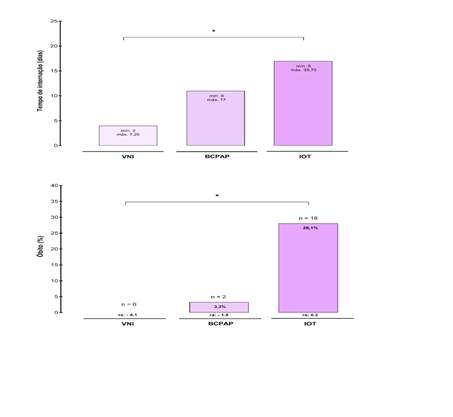
Table 1. Clinical
characteristics, therapeutic interventions, and complications of the overall
sample according to the type of ventilatory support
|
Variables
|
Total
N = 218
n (%)
|
VNI
N = 94
n (%)ar=number
|
BCPAP
N = 60
n (%)ar=number
|
IOT
N = 64
n (%)ar=number
|
p-value
|
|
Newborn’s
data
|
|
Gestational
age
|
|
< 28
|
14 (6.6)
|
0 (0.0)-3.4
|
0 (0.0)-2.4
|
14 (23.0)6.1
|
<0.001
|
|
28 - 32
|
31 (14.6)
|
0 (0.0)-5.3
|
16 (27.6)3.3
|
15 (24.6)2.6
|
|
33 - 36
|
46 (21.7)
|
22 (23.7)0.6
|
19 (32.8)2.4
|
5 (8.2)-3.0
|
|
37 - 41
|
121 (57.1)
|
71 (76.3)5.0
|
23 (39.7)-3.1
|
27 (44.3)-2.4
|
|
Birth
weight (g)
|
|
<1000
|
16 (7.8)
|
0 (0.0)-3.5
|
2 (3.3)-1.5
|
14 (23.0)5.3
|
<0.001
|
|
<1500
|
17 (8.3)
|
0 (0.0)-3.6
|
6 (10.0)0.6
|
11 (18,0)3.3
|
|
<2500
|
38 (18.5)
|
11 (13.1)-1.7
|
19 (31.7)3.1
|
8 (13.1)-1.3
|
|
2500 - 4000
|
124 (60.5)
|
66 (78.6)4.4
|
31 (51.7)-1.7
|
27 (44.3)-3.1
|
|
>4001
|
10 (4.9)
|
7 (8.3)1.9
|
2 (3.3)-0.7
|
1 (1.6)-1.4
|
|
RD
Etiologies
|
|
ERD
not specified
|
119 (54.6)
|
68 (72.3)4.6
|
24 (40.0)-2.7
|
27 (42.2)-2.4
|
<0.001
|
|
Neonatal
pneumonia
|
36 (16.5)
|
12 (12.8)-1.3
|
13 (21.7)1.3
|
11 (17.2)0.2
|
|
RDS
|
22 (10.1)
|
2 (2.1)-3.4
|
10 (16.7)2.0
|
10 (15.6)1.7
|
|
SAM
|
13 (6.0)
|
4 (4.3)-0.9
|
5 (8.3)0.9
|
4 (6.3)0.1
|
|
TTRN
|
11 (5.0)
|
7 (7.4)1.4
|
4 (6.7)0.7
|
0 (0.0)-2.2
|
|
Cardiopathies
|
7 (3.2)
|
1 (1.1)-1.6
|
2 (3.3)0.1
|
4 (6.3)1.6
|
|
Malformations
and others
|
6 (2.8)
|
0 (0.0)-2.2
|
1 (1.7)-0.6
|
5 (7.8)2.9
|
|
Perinatal
anoxia
|
3 (1.4)
|
0 (0.0)-1.4
|
0 (0.0)-1.1
|
3 (4.7)2.7
|
|
Apnea
of prematurity
|
1 (0.5)
|
0 (0.0)-0.9
|
1 (1.7)1.6
|
0 (0.0)-0.6
|
|
Neonatal
interventions and therapeutic support
|
|
Antibiotic
therapy
|
144 (66.7)
|
33 (35.9)-8.3
|
50 (83.3)3.2
|
61 (95.3)5.8
|
<0.001
|
|
Vasoavtive
drugs
|
48 (22.3)
|
0 (0.0)-6.8
|
14 (23.3)0.2
|
34 (54.0)7.2
|
<0.001
|
|
Surfactant
|
50 (23.5)
|
0 (0.0)-6.8
|
15 (25.0)0.3
|
35 (54.7)7.0
|
<0.001
|
|
Umbilical
catheter
|
92 (43.0)
|
0 (0.0)-10.8
|
36 (60.0)3.1
|
56 (87.5)8.6
|
<0.001
|
|
Nitric
oxide
|
7 (3.3)
|
0 (0.0)-2.3
|
1 (1.7)-0.8
|
6 (9.5)3.3
|
0.003
|
|
Adrenaline
|
35 (16.1)
|
1 (1.1)-5.2
|
10 (16.7)0.1
|
24 (37.5)5.5
|
<0.001
|
|
Complications arising from the use of ventilatory
support
|
|
Pneumothorax
|
9 (4.1)
|
0 (0.0)-2.7
|
3 (5.0)0.4
|
6 (9.4)2.5
|
0.015
|
|
Pleural effusion
|
1 (0.5)
|
0 (0.0)-0.9
|
0 (0.0)-0.6
|
1 (1.6)1.6
|
|
Pulmonary
hemorrhage
|
5 (2.3)
|
0 (0.0)-2.0
|
2 (3.3)0.6
|
3 (4.7)1.5
|
|
Broncodysplasia
|
8 (3.7)
|
0 (0.0)-2.5
|
4 (6.7)1.5
|
4 (12.5)1.3
|
0.043
|
UTI:
urinary tract infection, PIH: pregnancy-induced hypertension, GDM: gestational
diabetes mellitus, MgSO4: magnesium sulfate, ERD: early respiratory distress,
MAS: meconium aspiration syndrome, TTN: transient tachypnea of the newborn,
RDS: respiratory distress syndrome.
Source: The authors.
Logistic
regression analysis for mortality prediction
In logistic regression analysis, prematurity
was associated with a higher chance of death (OR: 5.7; 95% CI: 1.863-17.916;
p=0.002). The location of initial care showed a significant association with
mortality (OR: 0.5; 95% CI: 0.012-0.236; p<0.001). Variables related to greater
clinical severity, such as the use of an umbilical catheter (OR: 14.5; 95% CI:
3.291-64.713; p<0.001), antibiotic therapy (OR: 5.0; 95% CI: 1.127-22.181;
p=0.034), vasoactive drugs (OR: 29.9; 95% CI: 8.285-108.471; p<0.001),
adrenaline (OR: 19.5; 95% CI: 6.789-56.332; p<0.001) and nitric oxide (OR:
16.0; 95% CI: 3.291-77.791; p=0.001) were factors independently associated with
mortality. The use of surfactant showed a statistically significant association
with a lower chance of death (OR: 0.07; 95% CI: 0.025-0.217; p<0.001). The
presence of complications was associated with a higher risk of mortality (OR:
2.3; 95% CI: 1.334-4.214; p=0.003). The type of initial ventilatory support was
associated with mortality (OR: 14.2; 95% CI: 3.631-55.565; p<0.001), an interpretation
that should be cautious as it mainly reflects differences in baseline severity
between the groups and possible collinearity with therapeutic interventions
(Table 2).
Table 2. Logistic
regression of clinical variables associated with mortality in newborns with
respiratory distress syndrome
|
Variables
|
Death
|
|
OR
|
95% CI
|
p-value
|
|
Preterm
|
5.7
|
(1.863-17.916)
|
0.002
|
|
Gestational
age
|
1.0
|
(0.706-1.509)
|
0.871
|
|
Birth
weight (g)
|
0.9
|
(0.632-1.309)
|
0.609
|
|
Starting
point
|
0.5
|
(0.012-0.236)
|
<0.001
|
|
Etiologies
|
1.1
|
(0.978-1.145)
|
0.082
|
|
Umbilical
catheter
|
14.5
|
(3.291-64.713)
|
<0.001
|
|
Antibiotic
therapy
|
5.0
|
(1.127-22.181)
|
0.034
|
|
Vasoactive
drugs
|
29.9
|
(8.285-108.471)
|
<0.001
|
|
Adrenaline
|
19.5
|
(6.789-56.332)
|
<0.001
|
|
Surfactant
|
0.07
|
(0.025-0.217)
|
<0.001
|
|
Nitric
oxide
|
16.0
|
(3.291-77.791)
|
<0.001
|
|
Complications
|
2.3
|
(1.334-4.214)
|
0.003
|
|
Type
of ventilatory support
|
14.2
|
(3.631-55.565)
|
<0.001
|
OR: odds ratio, CI: Confidence interval. Type of ventilatory
support: NIV, BCPAP or IOT.
Source: The authors
DISCUSSION
The
findings of this study are consistent with the literature in showing that the
use of BCPAP is associated with more favorable clinical outcomes when compared
to IOT, especially in newborns with less clinical severity.13 In the
present study, newborns initially managed with BCPAP had a lower frequency of
complications related to ventilatory support, shorter hospital stay, and lower
mortality compared to the IOT group. The type of initial ventilatory support
showed significant association with mortality (OR: 14.2), a finding that should
be interpreted considering that MV tends to be used in newborns with more
complex clinical conditions, and not as evidence of a direct causal effect of
the technique.8
A greater
need for IOT was observed among extremely premature newborns (<28 weeks) and
those with low birth weight, especially <1,500g. On the other hand, newborns
with gestational age between 28-32 weeks and those with weight >1,500g had a
higher frequency of initial use of BCPAP. These findings are consistent with
the literature, which associates lower gestational age and low birth weight
with greater pulmonary immaturity and the need for more invasive ventilatory
support.14,15
In the
adjusted model, variables such as etiology of RD, birth weight, and gestational
age were not associated with mortality. Evidence describes BCPAP as a
frequently used strategy as initial support because it allows for ventilatory
stabilization without immediate intubation, and its indication should consider
the clinical context.9,16 Thus, initial ventilatory support should
also be understood as a marker of clinical severity, and not just as an
intervention.8,13
The
literature indicates that BCPAP failure rates vary between 20% and 30%,
especially in cases of greater clinical severity, making escalation to
intubation necessary.17,18 In this study, a failure rate of 33.4%
was observed in the BCPAP group, which is consistent with the literature.
Despite this, 19 newborns remained on BCPAP without needing initial intubation,
suggesting that this strategy may, in selected cases, postpone or avoid
exposure to complications associated with MV.
The use of
vasoactive drugs was lower in the BCPAP group in this study, compared with the
intubation group, possibly reflecting a profile of greater hemodynamic
stability, although subject to confounding due to severity. These findings are
consistent with previous evidence suggesting that MV may be associated with
greater cardiovascular instability due to adverse effects such as increased
intrathoracic pressure, reduced venous return, and impact on cardiac function.15,17
Similarly, the higher frequency of adrenaline use observed in the IOT group
should be interpreted as a marker of greater clinical severity and need for
advanced neonatal resuscitation, in accordance with the Neonatal Resuscitation
Program protocols, and should not be directly attributed to the initial
ventilatory mode.20,21
Previous
studies describe that the initial use of BCPAP may be associated with a lower
need for intubation and more favorable clinical outcomes, although it is not
effective in all cases.9 Our study demonstrates that the initial
respiratory support mode was associated with neonatal mortality, with a higher
proportion of deaths in the IOT group (28.1%) compared to the BCPAP group
(3.3%) (p<0.001). Similar results have been described in the
literature, which associates less invasive strategies with a lower occurrence
of MV-related complications, such as infections and lung injuries, which may
contribute to more favorable outcomes.22,23
A study
published in 2024, involving 440 newborns with gestational age <32 weeks, showed
an association between the use of BCPAP as primary support and lower mortality
rates.23 In addition, less invasive ventilatory strategies, such as
BCPAP, are associated with shorter MV time and reduced length of hospital
stays, fundamental aspects in neonatal recovery.24
In this
study, the BCPAP group had a shorter hospital stay compared to the IOT group (p<0.001),
possibly reflecting baseline differences between the groups.
This study
showed a lower prevalence of pulmonary complications in the BCPAP group
compared to the IOT group. The higher frequency of pneumothorax, BPD, and
pulmonary hemorrhage in the IOT group is consistent with previous studies
describing an association between mechanical ventilation and a higher
occurrence of adverse pulmonary events.9,25 These results reinforce
the role of BCPAP as an initial alternative, when clinically indicated, with
the potential to reduce complications.
Our
findings attest a lower need for invasive interventions in the BCPAP group,
including less surfactant use and less frequent antibiotic therapy, compared to
the IOT group. These results are aligned with the literature, which associates
the use of BCPAP with less exposure to invasive interventions.23,26
The high frequency of antibiotic therapy among intubated newborns reflects the
relationship between IOT and greater vulnerability to infections.27
Such associations may reflect confounding by indication and collinearity with
severity markers, and should be interpreted with caution.
This study
has limitations inherent to the retrospective cohort design, including the
possibility of selection bias and classification bias. Stratification by
gestational age or birth weight was not performed due to the limited number of
events and the risk of loss of statistical power. Initial ventilatory support
may reflect the baseline severity of newborns, acting as a severity marker.
Multiple secondary comparisons were performed without adjusting for
multiplicity, increasing the risk of type I error. Finally, the logistic regression
model included several covariates given a small number of outcomes, which can
lead to overfitting and unstable estimates
CONCLUSION
This study
showed an association between the use of BCPAP and lower mortality and length
of hospital stay in newborns with respiratory distress syndrome (RDS), when
compared to intubation. Differences in the clinical profile between the groups
limit causal inferences. The findings reinforce the role of BCPAP as an initial
respiratory support strategy in selected newborns, highlighting the importance
of appropriate clinical indication and rigorous monitoring for therapeutic
escalation when necessary
REFERENCES
1.
Carvalho
WB. Neonatologia. 2a ed. Barueri: Manole; 2020.
2.
Ferreira
CVL, Silva RM, Andrade TS, Oliveira JP, Santos LM, et al. Manejo da síndrome do
desconforto respiratório agudo em recém-nascidos prematuros: uma revisão
integrativa. Cienc Saude. 2023;27(121):1-8. doi:10.5281/zenodo.7867717.
3.
Ministério
da Saúde (BR). Sistema de Informações Hospitalares do SUS (SIH/SUS) [Internet].
Brasília: DATASUS; 2025 [cited 2025 set 24]. Disponível em:
http://www.datasus.gov.br
4.
Nunes
ABB, Silva RM, Costa LF, Pereira JF, Andrade TS, Oliveira JP, et al. A
efetividade do CPAP como suporte primário na síndrome de aspiração do mecônio
em neonatos: uma revisão integrativa. Fisioterapia. 2024;29(140):1-8.
doi:10.69849/revistaft/th102411211526.
5.
Leal
MDC, Esteves-Pereira AP, Viellas EF, Domingues RMSM, Gama SGND. Prenatal
care in the Brazilian public health services. Rev Saude Publica. 2020;54:8.
doi:10.11606/s1518-8787.2020054001458.
6.
Vidal
ECF, Oliveira LL, Oliveira CAN, Balsells MMD, Barros MAR, Vidal ECF, Pinheiro
AKB, Aquino PS. Prenatal care associated with neonatal outcomes in
maternity hospitals: a hospital-based cross-sectional study. Rev Esc Enferm
USP. 2023;57:e20230145. doi:10.1590/1980-220X-REEUSP-2023-0145en.
7.
Messias
MS, Silva JKAM, Santos AAP. Síndrome respiratória neonatal em relação à
operação de cesariana: revisão integrativa. Gep News. 2024;8(2):428-33.
8.
Hatch
LD 3rd, Clark RH, Carlo WA, Stark AR, Ely EW, Patrick SW. Changes in use of
respiratory support for preterm infants in the US, 2008-2018. JAMA Pediatr.
2021;175(10):1017-24. doi:10.1001/jamapediatrics.2021.1921.
9.
Ho
JJ, Subramaniam P, Davis PG. Continuous positive airway pressure (CPAP)
for respiratory distress in preterm infants. Cochrane Database Syst Rev.
2020;10:CD002271. doi:10.1002/14651858.CD002271.pub3.
10.
Fundação
Oswaldo Cruz. Instituto Nacional de Saúde da Mulher, da Criança e do
Adolescente Fernandes Figueira. Portal de boas práticas em saúde da mulher, da
criança e do adolescente: pressão positiva contínua das vias aéreas [Internet].
Rio de Janeiro: Fundação Oswaldo Cruz; 2017 [citado 2025 Jan 22]. Disponível
em: https://portaldeboaspraticas.iff.fiocruz.br/atencao-recem-nascido/cpap-nasal/
11.
Tinti
KC, Magalhães LM, Moreira MS, Oliveira P. O papel do CPAP na reanimação
neonatal: uma revisão abrangente da literatura. Rev Foco. 2024; e5560:1-8.
doi:10.54751/revistafoco.ed.esp-026.
12.
Gupta
S, Donn SM. Continuous positive airway pressure: to bubble or not to bubble?
Clin Perinatol. 2016;43(4):647-59. doi:10.1016/j.clp.2016.07.003.
13.
Junqueira
GH, Silva RM, Andrade TS, Pereira JF, Costa LF, Oliveira JP, et al. Comparação
dos modos ventilatórios utilizados em uma unidade de terapia intensiva
neonatal. Cienc Saude. 2024;29(140):1-8.
doi:10.69849/revistaft/cs10202411141323.
14.
Lipp
R, Canadian Neonatal Network, Canadian Preterm Birth Network, Canadian Neonatal
Follow Up Network Investigators, et al. Noninvasive respiratory support or
intubation during stabilization after birth and neonatal and neurodevelopmental
outcomes in infants born preterm at 23-25 weeks of gestation. J Pediatr.
2025;276:114270. doi:10.1016/j.jpeds.2024.114270.
15.
Schulzke
SM, Stoecklin B. Update on ventilatory management of extremely preterm infants:
a neonatal intensive care unit perspective. Paediatr Anaesth. 2022;32(2):363-71.
doi:10.1111/pan.14369.
16.
Lemyre
B, Deguise MO, Benson P, Kirpalani H, Ekhaguere OA, Davis PG. Early
nasal intermittent positive pressure ventilation (NIPPV) versus early nasal
continuous positive airway pressure (NCPAP) for preterm infants. Cochrane Database
Syst Rev. 2023;7:CD005384. doi:10.1002/14651858.CD005384.pub3.
17.
Miyoshi
MH. Suporte respiratório no recém-nascido prematuro. In: Sociedade Brasileira
de Pediatria. Manual de orientação: Departamento Científico de Neonatologia
(2019-2021). Nº 12. São Paulo: Sociedade Brasileira de Pediatria; 2022.
18.
Bharadwaj
SK, Alonazi A, Banfield L, Dutta S, Mukerji A. Bubble versus other continuous
positive airway pressure forms: a systematic review and meta-analysis. Arch Dis Child Fetal
Neonatal Ed. 2020;105(5):526-31. doi:10.1136/archdischild-2019-318165.
19.
Prestes
D, Antunes VP, Cardoso DM, Bajotto AP, Pasqualoto AS. Características de
neonatos com síndrome do desconforto respiratório considerando a via de parto
em uma unidade de terapia intensiva da região central do RS. Rev Bras Cienc
Saude. 2019;23(3):393-8.
20.
Guinsburg
R, Almeida MFB; Coordenadores Estaduais e Grupo Executivo PRN-SBP; Conselho
Científico Departamento Neonatologia SBP. Reanimação do recém-nascido <34
semanas em sala de parto: diretrizes 2022 da Sociedade Brasileira de Pediatria.
Rio de Janeiro: Sociedade Brasileira de Pediatria; 2022. https://doi.org/10.25060/PRN-SBP-2022-1
21.
Machado
MEM, Waltrick K, Gonçalves I, Machado S, Boldrini S, Luersen L, et al. Bubble
CPAP como estratégia inicial em prematuros: evidências de uma coorte
retrospectiva. Rev Ped SOPERJ. 2025;25(0):1-12
22.
Nunes
G, Barbosa de Oliveira C, Zeid M, Leone M, Mardakis S, Remmer E, et al. Early
bubble CPAP protocol implementation and rates of death or severe BPD.
Pediatrics. 2024;154(1):e2023065373. doi:10.1542/peds.2023-065373.
23.
Abiramalatha
T, Smith J, Brown T, Oliveira JP, Costa LF, Santos RM, et al. Interventions to
prevent bronchopulmonary dysplasia in preterm neonates: an umbrella review of
systematic reviews and meta-analyses. JAMA Pediatr. 2022;176(5):502-16. Disponível
em: https://pubmed.ncbi.nlm.nih.gov/35226067/
24.
Pereira
DR, Souza ML, Andrade TS, Oliveira JP, Costa LF, Silva RM, et al. Os efeitos do
CPAP selo d'água em recém-nascidos prematuros: uma revisão integrativa. Braz J
Health Rev. 2023;6(1):491-505. doi:10.34119/bjhrv6n1-040.
25.
Stocks
EF, Smith J, Brown T, Oliveira JP, Costa LF, Santos RM, et al. Decreasing
delivery room CPAP associated pneumothorax at ≥35 weeks’ gestational age. J Perinatol.
2022;42(6):761-8. Disponível em: https://pubmed.ncbi.nlm.nih.gov/35173286/
26.
Rojas
JPA, Camargo CR, Fernandes I. Desfecho da utilização do CPAP bolha e CPAP
convencional no tratamento da síndrome do desconforto respiratório em neonatos
prematuros. Cienc Saude. 2023;27(120):1-8. doi:10.5281/zenodo.7772023.
27.
Medeiros
FVA, Alves VH, Valete COS, Paiva ED, Rodrigues DP, Souza RRB. Procedimentos
invasivos e sepse em recém-nascidos de muito baixo peso: estudo descritivo.
Online Braz J Nurs. 2016;15(2):244-53.
28.
Organização
Mundial da Saúde. CID-10: classificação estatística internacional de doenças e
problemas relacionados à saúde [Internet]. 10ª revisão. Genebra: Organização
Mundial da Saúde; 2019 [citado em 27 fev 2026].
Supplementary Table
1. Apgar
score, mode of delivery, and maternal variables
|
Variables
|
Total
N = 218
n (%) / Med (IIQ)
|
NIV
N = 94
n (%)ar=number
/ Med (IIQ)
|
BCPAP
N = 60
n (%)ar=number
/ Med (IIQ)
|
IOT
N = 64
n (%) ar=number
/ Med (IIQ)
|
p-value
|
|
Newborn’s
data2
|
|
|
Sex2
|
|
|
Female
|
100 (45.9)
|
53 (56.4)2.7
|
24 (40.0)-1.1
|
23 (35.9)-1.9
|
0.023
|
|
Male
|
118 (54.1)
|
41 (43.6)-2.7
|
36 (60.0)1.1
|
41 (64.1)1.9
|
<0.001
|
|
Apgar
1
|
|
|
1st minute
|
7.0 (5.0-8.0)
|
7.0 (6.0-8.0)
|
8.0 (6.0-8.0)
|
6.0 (4.0-7.75)
|
0.005
|
|
5th minute
|
8.0 (7.75-9.0)
|
8.0 (8.0-9.0)
|
9.0 (8.0-9.0)
|
8.0 (7.0-9.0)
|
0.008
|
|
Maternal
and gestational data1
|
|
|
Age
|
27.0 (22.5-32.0)
|
27.0 (24.0-32.0)
|
27.0 (22.0-33.5)
|
28.0 (23.0-32.0)
|
0.973
|
|
Prenatal
|
8.0 (6.0-11.0)
|
9.0 (7.0-12.0)
|
8.0 (5.5-11.0)
|
7.0 (5.0-10.0)
|
0.002
|
|
Comorbidities2
|
|
|
Hypothyroidism
|
31 (18.7)
|
17 (22.4)1.1
|
9 (18.8)0.0
|
5 (11.9)-1.3
|
0.377
|
|
Arterial hypertension
|
19 (11.4)
|
10 (13.2)0.6
|
5 (10.4)-0.3
|
4 (9.5)-0.5
|
0.809
|
|
Depression / anxiety
|
12 (7,2)
|
6 (7,9)0.3
|
3 (6,3)-0.3
|
3 (7,1)0.0
|
0,942
|
|
Others
|
17 (10,2)
|
10 (13,2)1.1
|
4 (8,3)-0.5
|
3 (7,1)-0.8
|
0,514
|
|
Pregnancy
complications 2
|
|
|
UTI
|
47 (25.8)
|
22 (29.7)1.0
|
12 (22.6)-0.6
|
13 (23.6)-0.4
|
0.604
|
|
PIH
|
36 (19.8)
|
12 (16.2)-1.0
|
16 (30.2)2.3
|
8 (14.5)-1.2
|
0.076
|
|
GDM
|
40 (22.0)
|
23 (31.1)2.5
|
10 (18.9)-0.6
|
7 (12.7)-2.0
|
0.037
|
|
Others
|
38 (20.9)
|
10 (13.5)-2.0
|
8 (15.1)-1.2
|
20 (36.4)3.4
|
0.003
|
|
Medications
in use2
|
|
|
Levothyroxine
|
31 (15.1)
|
15 (16.1)0.4
|
10 (19.2)1.0
|
6 (10.0)-1.3
|
0.371
|
|
Methyldopa
|
34 (16.7)
|
17 (18.7)0.7
|
10 (19.2)0.6
|
7 (11.7)-1.3
|
0.453
|
|
Metformin
|
17 (8.4)
|
8 (8.8)0.2
|
7 (13.5)1.5
|
2 (3.3)-1.7
|
0.152
|
|
Antidepressants
|
11 (5.4)
|
7 (7.7)1.3
|
2 (3.8)-0.6
|
2 (3.4)-0.8
|
0.434
|
|
Others
|
32 (15.7)
|
15 (16.5)0.3
|
12 (22.6)1.6
|
5 (8.3)-1.9
|
0.109
|
|
Mode
of delivery2
|
|
|
Vaginal
|
67 (31.2)
|
29 (31.5)0.1
|
12 (20.0)-2.2
|
26 (41.3)2.1
|
0.039
|
|
Cesarean
|
148 (68.8)
|
63 (68.5)-0.1
|
48 (80.0)2.2
|
37 (58.7)-2.1
|
|
Interventions
and gestational conditions2
|
|
|
MgSO4
|
20 (20.4)
|
1 (4.3)-2.2
|
5 (14.3)-1.1
|
14 (35.0)3.0
|
0.008
|
|
Antenatal corticosteroid
|
41 (32.8)
|
2 (4.8)-4.7
|
16 (38.1)0.9
|
23 (56.1)3.9
|
<0.001
|
|
Antibiotic therapy
|
81 (54.4)
|
32 (53.3)-0.2
|
21 (46.7)-1.2
|
28 (63.6)1.5
|
0.269
|
|
Ruptured bag
|
67 (37.6)
|
23 (32.9)-1.1
|
14 (25.9)-2.1
|
30 (55.6)3.3
|
0.004
|
|
Positive Streptococcus B
|
16 (16.8)
|
10 (20.0)0.9
|
0 (0.0)-2.0
|
6 (21.4)0.8
|
0.121
|
|
Ventilatory
support2
|
|
|
Starting
in the delivery room2
|
82 (37.6)
|
13 (13.8)-6.3
|
24 (40.0)0.4
|
45 (70.3)6.4
|
<0.001
|
|
Starting
in the NICO2
|
136 (62.4)
|
81 (86.2)6.3
|
36 (60.0)-0.4
|
19 (29.7)-6.4
|
|
Need
for change2
|
43 (20.2)
|
24 (25.6)
|
19 (33.4)
|
0 (0.0)
|
<0.001
|
|
Time
(days)1
|
4.0 (2.0-10.0)
|
2.0 (1.0-2.0)
|
6.0 (3.0-9.0)
|
14.0 (5.0-26.5)
|
<0.001
|
Scientific
Editor:
Fernanda
Pinto Mariz
ORCID: https://orcid.org/0000-0002-6981-2352
Publisher: Sociedade
de Pediatria do Rio de Janeiro – SOPERJ
E-mail:
secretaria@soperj.org.br
Financial support:
None.
Availability of research data:
The
underlying content of the research text is contained in the article.
Conflict of interests:
None.
Authors’ contributions:
N. G. da Cruz:
statistical analysis, data collection, conceptualization, project management,
investigation, methodology, writing - preparation of the original, writing -
revision and editing, supervision, visualization.
M. C. F. Dalri:
conceptualization, project management, writing - revision and editing,
supervision.
S. Lopes: statistical
analysis, project management, methodology, writing - revision and editing,
supervision.
A. C. A. Benvenutti:
data collection.
L. B. Schlichting:
data collection.
Y. R. Braun: data collection.
Rev Pediatria SOPERJ 2026;26(3):
e20260401