ORIGINAL ARTICLE
Submitted: 16/12/2025
Approved: 06/02/2026
DOI: http://dx.doi.org/10.31365/issn.2595-1769.2026.0403
Prevalência de paralisia cerebral e sua distribuição motora em crianças acompanhadas em um Centro de Reabilitação no Rio de Janeiro
Prevalencia de la parálisis cerebral y su distribución motora en niños acompañados en un Centro de Rehabilitación en Rio de Janeiro
Marta Cristina da Silva Teixeira1
Fernanda J. P. Marques2
1 Rede SARAH de hospitais de reabilitação, Pediatria - Rio de Janeiro-RJ, Brazil. https://orcid.org/0009-0006-4988-3774
2 University of Iowa Health Care, Developmental and Behavioral Pediatrics - Iowa City-IA, USA. https://orcid.org/0000-0002-4581-6025
Corresponding author:
Marta Cristina da Silva Teixeira
E-mail: teixeira.marta@uol.com.br
ABSTRACT
Introduction: In Brazil, epidemiological data on cerebral palsy remain limited. Understanding its profile within the Brazilian context is crucial to guide appropriate treatment and policy development. Objective: Describe the clinical profile of a subset of children with the diagnosis of CP and its motor distribution from a rehabilitation center located in Rio de Janeiro, Brazil. Method: This retrospective cross-sectional study was conducted from November 2023 to June 2024. Data were collected from a randomized group of children with CP. Also, the participants were classified according to the Gross Motor Function Classification System (GMFCS). Results: Sample included 756 children with CP; 436 (57.7%) participants were male, and 320 (42.3%) females The most common risk factor was preterm hypoxic-ischemic insult (36.6%). Spastic (77.9%) quadriplegia (55.3%) was the most common clinical presentation. Comorbidities including epilepsy (62.7%), dysphagia (43.3%), sialorrhea (30.2%) and constipation (32.1%) were noted. Hip dislocations (45.8%) and scoliosis (24.6%) were the most common orthopedic conditions. GMFCS classified 303 (40.1%) participants as level V; 118 (15.6%) level IV; 88 (11.6%) level III, 67 (8.9%) level II and 127 (16.8%) level I. Neuroimaging findings comprise hypoxic-ischemic injury (54.1%) as the most prevalent finding. Conclusion: Most children with CP in our sample have severe functional impairment, increasing the risk of adverse outcomes including higher rates of clinical comorbidities such as epilepsy. Implementing comprehensive public policies and rehabilitation strategies is essential to ensure continuous, high-quality care for this population.
Keywords: Cerebral palsy; Child development; Motor skills disorders.
RESUMO
Introdução: No Brasil, os dados epidemiológicos sobre paralisia cerebral ainda são limitados. Conhecer seu perfil no contexto nacional é fundamental para orientar condutas terapêuticas adequadas e subsidiar o desenvolvimento de políticas públicas. Objetivo: Descrever o perfil clínico e a distribuição motora de crianças com diagnóstico de paralisia cerebral atendidas em um centro de reabilitação no Rio de Janeiro. Método: Estudo transversal retrospectivo, realizado entre novembro de 2023 e junho de 2024. Foram analisados dados de um grupo randomizado de crianças com paralisia cerebral, classificadas segundo o Gross Motor Function Classification System (GMFCS). Resultados: Foram incluídas 756 crianças, sendo 436 (57,7%) do sexo masculino e 320 (42,3%) do feminino. O fator de risco mais frequente foi insulto hipóxico-isquêmico associado a prematuridade (36,6%). A forma clínica predominante foi a paralisia cerebral espástica (77,9%) tetraplégica (55,3%). As principais comorbidades foram epilepsia (62,7%), disfagia (43,3%), sialorreia (30,2%) e constipação intestinal (32,1%). Entre as condições ortopédicas, destacaram-se luxação de quadril (45,8%) e escoliose (24,6%). Quanto ao GMFCS, 303 (40,1%) foram classificados no nível V, 118 (15,6%) no IV, 88 (11,6%) no III, 67 (8,9%) no II e 127 (16,8%) no I. Os achados de neuroimagem revelaram lesão hipóxico-isquêmica como o mais prevalente (54,1%). Conclusão: A maioria das crianças apresentou comprometimento funcional grave, associado a maiores taxas de comorbidades clínicas, especialmente epilepsia. Torna-se essencial a implementação de políticas públicas e estratégias de reabilitação abrangentes para garantir cuidados contínuos e de qualidade a essa população.
Palavras-chave: Paralisia cerebral; Desenvolvimento infantil; Transtornos das habilidades motoras.
RESUMEN
Introducción: En Brasil, los datos epidemiológicos sobre parálisis cerebral aún son limitados. Comprender su perfil en el contexto nacional es fundamental para orientar los enfoques terapéuticos adecuados y apoyar el desarrollo de políticas públicas. Objetivo: Describir el perfil clínico y la distribución motora de los niños con diagnóstico de parálisis cerebral atendidos en un centro de rehabilitación en Río de Janeiro. Método: Estudio transversal retrospectivo, realizado entre noviembre de 2023 y junio de 2024. Se analizaron los datos de un grupo aleatorizado de niños con parálisis cerebral, clasificados según el Sistema de Clasificación de la Función Motora Gruesa (GMFCS). Resultados: Se incluyeron 756 niños, 436 (57,7%) varones y 320 (42,3%) mujeres. El factor de riesgo más frecuente fue la lesión hipóxico-isquémica asociada a la prematuridad (36,6%). La forma clínica predominante fue la parálisis cerebral espástica (77,9%) y la tetrapléjica (55,3%). Las principales comorbilidades fueron epilepsia (62,7%), disfagia (43,3%), sialorrea (30,2%) y estreñimiento (32,1%). Entre las afecciones ortopédicas, destacaron la luxación de cadera (45,8%) y la escoliosis (24,6%). En cuanto al GMFCS, 303 (40,1%) se clasificaron en el nivel V, 118 (15,6%) en el IV, 88 (11,6%) en el III, 67 (8,9%) en el II y 127 (16,8%) en el I. Los hallazgos de neuroimagen revelaron que la lesión hipóxico-isquémica fue la más prevalente (54,1%). Conclusión: La mayoría de los niños presentaron deterioro funcional grave, asociado con mayores tasas de comorbilidades clínicas, especialmente epilepsia. La implementación de políticas públicas integrales y estrategias de rehabilitación es esencial para garantizar una atención continua y de calidad para esta población.
Palabras clave: Parálisis cerebral; Desarrollo infantil; Trastornos de las habilidades motoras.
INTRODUCTION
Cerebral palsy (CP) describes a group of developmental disorders related to movement and posture, attributed to non-progressive disturbances that occur in brain development.1 Risk factors include genetic variants, congenital anomalies, premature birth, kernicterus, intrauterine growth restriction, intrauterine and perinatal infections, hypoxic-ischemic and cerebrovascular insults during pregnancy or childhood, as well as accidental or non-accidental brain injuries.² CP is associated with long-term consequences that substantially affect the quality of life of children and their families.
Children with CP in low- and middle-income countries (LMICs) often present with more severe motor limitations, higher rates of comorbidities, and later age at diagnosis, compared to those in high-income countries (HICs). In HICs, advances in neonatal and perinatal care have reduced the prevalence of CP.3,4
CP profiles also differ in terms of research coverage: while HICs benefit from large-scale national registries and longitudinal studies, LMICs face a significant lack of epidemiological data. This scarcity hinders accurate prevalence estimates, delays the identification of population-specific risk factors, and limits the design of effective family-centered intervention strategies.5,6 Consequently, rehabilitation goals in LMICs may not fully address the severity of disabilities or the broader needs of affected children and their families. Strengthening epidemiological surveillance and establishing national CP registries are essential steps to improve early diagnosis, appropriate interventions, and targeted public health policies.
In Brazil, epidemiological data on CP remain limited. CP encompasses a heterogeneous group of chronic conditions with profound social and economic implications. For this reason, understanding their clinical and motor profile in the Brazilian context is crucial to guide appropriate treatment and policy development. This study aims to describe the clinical characteristics and motor distribution of children diagnosed with CP treated at a rehabilitation center in Rio de Janeiro, Brazil.
METHODS
This retrospective cross-sectional study was conducted from November 2023 to June 2024 at a national referral rehabilitation center for children with CP in Rio de Janeiro, Brazil.
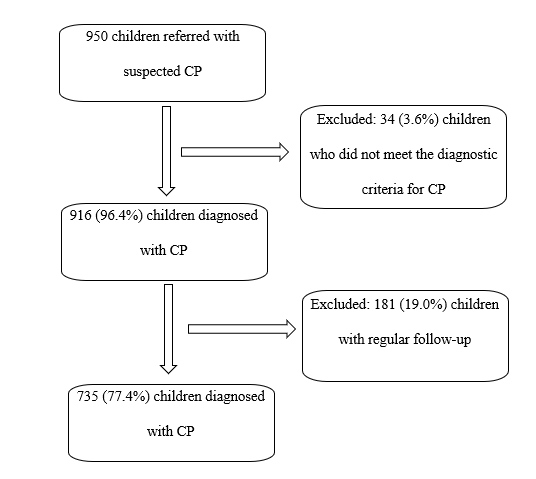
The study population included children evaluated between January 2018 and December 2022 with a suspected diagnosis of CP. The inclusion criterion was a confirmed diagnosis of CP, made by five developmental pediatricians, based on the presence of motor dysfunction (essential criterion) and at least one of the following additional criteria: abnormal neuroimaging and/or clinical history consistent with risk factors for CP.⁵ Exclusion criteria included irregular follow-up (children who attended only the initial assessment, without returning for follow-up) or who did not meet the criteria for a diagnosis of CP. Figure 1 shows the process of selection of participants.
FIGURE 1 - Flowchart representing the selection of participants
Demographic data and clinical characteristics were collected from medical records. CP was also described according to its topography (tetraplegia, hemiplegia, diplegia, and triplegia) and type (spastic, dyskinetic, ataxic, or mixed). Etiological risk factors were also included, in addition to clinical comorbidities associated with the diagnosis of CP.
Neuroimaging studies were peer-reviewed by two radiologists specializing in neuroradiology. Magnetic resonance imaging (MRI) and/or computed tomography (CT) were performed in states of spontaneous sleep. Most of these examinations were performed at the institution, and external examinations performed under the same conditions were accepted, with images also reviewed and reassessed by the same two radiologists specializing in neuroradiology. The findings were categorized as hypoxic-ischemic lesion, sequelae of congenital infection, schizencephaly, hydrocephalus, other malformations, sequelae of stroke, kernicterus, or other abnormalities.
Furthermore, participants were classified according to the Gross Motor Function Classification System (GMFCS).⁷ GMFCS comprises five levels of gross motor classification based on the child’s motor functioning and is used to classify the severity of mobility. The classification emphasizes the level of functioning of the child’s main postures, such as sitting (trunk control) and walking, in five different age ranges (<2 years, 2-4 years, 4-6 years, 6-12 years, and 12-18 years). The classification system has five levels; with level I equivalent to minimal motor dysfunction and level V to the most significant motor impairment.3 GMFCS classification was performed jointly by the developmental pediatrics team and the physiotherapy team of the unit.
Data extraction from medical records was performed by healthcare professionals (developmental pediatricians), using a standardized and previously structured clinical record. Data collection and review were conducted independently by both researchers, with subsequent cross-checking to identify inconsistencies.
Statistical analysis was performed using SPSS 21.0™. Categorical variables were described as absolute and relative frequencies. Continuous variables were expressed as mean and standard deviation. The study protocol was approved by the institution’s research ethics committee and registered on the Plataforma Brasil (www.saude.gov.br/plataformabrasil) under CAAE No. 43352621.0.0000.0022. Informed consent was obtained from the parents or legal guardians of the participants.
RESULTS
This study analyzed 756 children diagnosed with CP at a national referral rehabilitation center (SARAH Network of Rehabilitation Hospitals). Of these, 436 (57.7%) were male and 320 (42.3%) were female. The most common risk factor was preterm hypoxic-ischemic insult (36.6%), followed by term hypoxic-ischemic insult (30.3%). Regarding topography and type, tetraplegia (55.3%) and spasticity (77.9%) were, respectively, the most common clinical presentations. Comorbidities were observed, including epilepsy (62.7%), and clinical conditions such as dysphagia (43.3%), sialorrhea (30.2%), constipation (32.1%), hearing deficits (18.4%), and visual deficits (13.8%). Orthopedic complications were also frequent, particularly hip dislocation (45.8%) and scoliosis (24.6%).
Among participants older than two years, the GMFCS distribution revealed that 303 (40.1%) were classified as level V; 118 (15.6%), as level IV; 88 (11.6%), as level III; 67 (8.9%), as level II; and 127 (16.8%), as level I.
Hypoxic-ischemic injury was the most common finding (54.1%), followed by other congenital and acquired brain abnormalities.
Table 1 summarizes the demographic and clinical profile.
TABELA 1 - Características demográficas e clínicas dos participantes
|
|
% ou média (min-max) |
|
Gênero . feminino . masculino |
320/756 (42,3%) 436/756 (57,7%) |
|
Idade admissão (meses) |
39,2 (1-294) |
|
Fator de risco . insulto hipóxico-isquêmico associado a prematuridade . insulto hipóxico-isquêmico a termo . infecção congênita . kernicterus . encefalites . malformação encefálica . AVC . traumatismo cranioencefálico . condição genética / desconhecida |
277/756 (36,6%)
229/756 (30,3%) 66/756 (8,7%) 15/756 (2,0%) 9/756 (1,2%) 21/756 (2,8%) 14/756 (1,9%) 3/756 (0,4%) 122/756 (16,1%) |
|
Topografia . hemiplegia . diplegia . triplegia . tetraplegia . desconhecido / sem registro |
138/756 (18,3%) 123/756 (16,3%) 55/756 (7,3%) 418/756 (55,3%) 22/756 (2,9%) |
|
Tipo . espasticidade . discinético . atáxico . misto . desconhecido / sem registro |
589/756 (77,9%) 29/756 (3,8%) 2/756 (0,3%) 123/756 (16,3%) 13/756 (1,7%) |
|
GMFCS . I . II . III . IV . V . desconhecido / sem registro |
127/756 (16,8%) 67/756 (8,9%) 88/756 (11,6%) 118/756 (15,6%) 303/756 (40,1%) 53/756 (7,0%) |
|
Comorbidades clínicas . epilepsia (156 desconhecidos / sem registro) . disfagia (329 desconhecidos / sem registro) . sialorreia (358 desconhecidos / sem registro) . constipação (404 desconhecidos / sem registro) . déficit auditivo (392 desconhecidos / sem registro) . déficit visual (409 desconhecidos / sem registro) . escoliose (399 desconhecidos / sem registro) . sub/luxação do quadril (335 desconhecidos / sem registro) |
376/600 (62,7%)
185/427 (43,3%)
120/398 (30,2%)
113/352 (32,1%)
67/364 (18,4%)
48/347 (13,8%)
88/357 (24,6%)
193/421 (45,8%) |
Abbreviations: GMFCS, Gross Motor Function Classification System.
Source: the authors.
DISCUSSION
Cerebral palsy is a permanent condition with a lifelong impact on the quality of life of these children and their families, and it is essential to understand the demographic and clinical profile of this population in PBMRs.6 Some of the main results are discussed below.
In this study, the average age at admission was 39.2 months – considered late for the evaluation of children with suspected CP. This period exceeds the ideal period for interventions, since neuronal plasticity is greater in the first two years of life.8,9 Since the 19th century, literature has advocated for the early diagnosis of CP.10 However, since Brazil does not have a national registry of CP, there are no reliable studies on the national average age of diagnosis of CP in this population.
Considering LMICs, similar to Brazil, a study conducted in Bangladesh revealed that the average age of diagnosis is currently five years.8 Late diagnosis has been associated with limited access to early interventions in children from Bangladesh, creating a discrepant scenario when compared to HIC. In these contexts, the diagnosis of CP is generally established between 12 and 24 months of age, which allows for timely referral for specific interventions and stimulation activities, promoting the start of therapeutic follow-up at earlier stages of development.10
In agreement with a previous cross-sectional study conducted in a capital city in northeastern Brazil, our findings revealed that bilateral spastic CP was the most prevalent clinical presentation (45.4% and 55.3%, respectively).⁶ These results are similar to those of HICs registries,11,12,13 such as the Australian Cerebral Palsy Registry (ACPR).4 According to the ACPR, CP is categorized as unilateral in 41% of affected children and bilateral in 59%.
In addition, the GMFCS showed predominance of severe forms of motor impairment. In our study, 422 children with CP were classified in levels V and IV of the GMFCS (40.1% and 15.6%, respectively). This result reflects that more than half of our sample requires mobility methods that require physical assistance or motorized mobility. In contrast, according to the Centers for Disease Control and Prevention (CDC), more than half (58.9%) of children identified with CP in the United States were able to walk independently.14 This discrepancy likely reflects, in the population evaluated in this study, a higher incidence of severe forms of brain injury and a higher occurrence of clinical comorbidities, as already described in the literature.15,16
In contrast, clinical comorbidities, such as epilepsy, affected 62.7% of children with CP, a much higher rate than that reported in HICs.17,18 According to the ACPR, epilepsy affects 25% of children with CP. Data from the CDC reported that 42% of children in the United States identified with CP had concomitant epilepsy.12 The presence of comorbid diagnoses, such as epilepsy, contributes to greater clinical instability, more unfavorable developmental prognoses, and even earlier mortality rates. These differences may be attributed to greater severity of brain damage, possibly due to differences in pre- and perinatal care.
In the last 15 years, the prevalence of CP in HICs has decreased by 40%, reflecting, in part, advances in perinatal and neonatal care.11,12,13 In contrast, reports from Bangladesh⁸ and Uganda19 suggest that the number of children with CP is increasing, with an estimated rate of 3.1 and 3.7/1,000 live births, respectively. These data suggest important epidemiological disparities, possibly reflecting variations in access to neonatal care and other social and health determinants between HICs and LMICs.
This study has some limitations. As a retrospective study, there is a high rate of unrecorded/missing data for some of the variables analyzed, especially regarding clinical data. Furthermore, the results showed a descriptive analysis of children with CP in a rehabilitation center, a limitation for the external validity of the results. Additionally, the authors did not consider the characteristics of the health services received before data collection, the age of initiation of care at the specialized center, or the factors influencing these aspects, as this is a descriptive study on the clinical profile of a subgroup of children with CP, without the aim of analyzing intervention and clinical outcomes. Furthermore, the study spanned the period of the Covid-19 pandemic, which may have interfered with the results. Finally, there are few studies on the profile of CP in lower-middle-income countries – consequently, there is little data for comparison with other centers of a similar nature.
CONCLUSION
This study aimed to contribute to a better understanding of the clinical and demographic profile of these children in Brazil. There has been a recent increase in CP registrations worldwide, particularly in LMICs, which will improve the understanding of the epidemiology of CP.
Future multicenter studies with a larger sample are needed to profile this population, which is essential to guide rehabilitation programs and public policies that benefit children and families affected by this permanent health condition.20,21
REFERÊNCIAS
1. Rosenbaum P, Paneth N, Leviton A, Goldstein M, Bax M, Damiano D, et al. A report: the definition and classification of cerebral palsy April 2006. Dev Med Child Neurol Suppl. 2007; 109:8-14.
2. Nelson KB, Blair E. The epidemiology of cerebral palsy. In: Clinics in Developmental Medicine. London: Mac Keith Press; 2015. p. 13-22.
3. Australian Cerebral Palsy Register Group. Report of the Australian Cerebral Palsy Register, birth years 1995-2014. Sydney: ACPR; 2018.
4. Novak I, Jackman M, Finch-Edmondson M, Fahey M. Cerebral palsy. Lancet. 2025;406(10499):174-88. doi:10.1016/S0140-6736(25)00686-5.
5. Karim T, Muhit M, Khandaker G. Epidemiology of cerebral palsy in children in low- and middle-income countries: prevalence and risk factors. Int J Disabil Dev Educ. 2019;66(6):649-60.
6. Vasconcelos RLP, Moura TL, Campos TF, Lindquist ARR, Guerra RO. Clinical profile of children with cerebral palsy attending a referral center in northeastern Brazil. Rev Paul Pediatr. 2009;27(3):303-8.
7. Rosenbaum PL, Palisano RJ, Bartlett DJ, Galuppi BE, Russell DJ. Development of the Gross Motor Function Classification System for cerebral palsy. Dev Med Child Neurol. 2008;50(4):249-53.
8. Karim T, Muhit M, Khandaker G, Smithers-Sheedy H, Novak I. Epidemiology of cerebral palsy in low- and middle-income countries: insights from Bangladesh. J Pediatr Child Health. 2019;55(5):582-8.
9. Kolb B, Gibb R. Brain plasticity and behaviour in the developing brain. J Can Acad Child Adolesc Psychiatry. 2011;20(4):265-76.
10. Little WJ. The influence of abnormal parturition, difficult labours, premature birth, and asphyxia neonatorum, on the mental and physical condition of the child. Trans Obstet Soc Lond. 1862; 3:293-344.
11. McIntyre S, Goldsmith S, Webb A, Ehlinger V, Hollung SJ, McConnell K, et al. Global prevalence of cerebral palsy: a systematic analysis. Dev Med Child Neurol. 2022;64(12):1494-506.
12. Australian Cerebral Palsy Register Group. Australian Cerebral Palsy Register Report 2023: birth years 1995-2016. Sydney: ACPR; 2023.
13. Lacey C, et al. Cerebral palsy in Australia: birth prevalence, 1995–2016, and differences by residential location. Med J Aust. 2024;221(10).
14. Christensen D, Van Naarden Braun K, Doernberg NS, Maenner MJ, Arneson CL, Durkin MS, et al. Prevalence of cerebral palsy, co-occurring autism spectrum disorders, and motor functioning – Autism and Developmental Disabilities Monitoring Network, USA, 2008. Dev Med Child Neurol. 2014;56(1):59-65.
15. Mazzitelli C, et al. Functioning profile and related impairments of children and adolescents with cerebral palsy from various Brazilian regions. BMC Pediatr. 2024;24.
16. de Souza R, et al. Epidemiological and functional profile of children with cerebral palsy. Children (Basel). 2025;12.
17. Gong C, Liu A, Lian B, Wu X, Zeng P, Hao C, et al. Prevalence and related factors of epilepsy in children and adolescents with cerebral palsy: a systematic review and meta-analysis. Front Pediatr. 2023; 11:1220308.
18. Pavone P, et al. Epilepsy in cerebral palsy: prevalence, risk factors and clinical features. J Clin Med. 2023;12(1):346.
19. Kakooza-Mwesige A, Andrews C, Peterson S, Mangen FW, Eliasson AC, Forssberg H. Prevalence of cerebral palsy in Uganda: a population-based study. Lancet Glob Health. 2017;5(12): e1275-82.
20. Novak I, Morgan C, Adde L, Blackman J, Boyd RN, Brunstrom-Hernandez J, et al. Early, accurate diagnosis and early intervention in cerebral palsy: advances in diagnosis and treatment. JAMA Pediatr. 2017;171(9):897-905.
21. American Academy for Cerebral Palsy and Developmental Medicine (AACPDM). Hip Surveillance in Cerebral Palsy Care Pathway. 2024 update. Available from AACPDM.
Scientific Editor:
Fernanda Pinto Mariz
ORCID: https://orcid.org/0000-0002-6981-2352
Publisher:
Sociedade de Pediatria do Rio de Janeiro – SOPERJ
E-mail: secretaria@soperj.org.br
Financial support:
None.
Availability of research data:
The underlying content of the research text is contained in the article.
Conflict of interests:
None.
Authors’ contributions:
MCS Teixeira: statistical analysis, data collection, conceptualization, resource management, project management, investigation, methodology, writing – preparation of the original manuscript, writing – revision and editing, supervision, validation and visualization.
FJP Marques: statistical analysis, data collection, project management, methodology, writing – preparation of the original manuscript, writing – revision and editing, visualization.
Rev Pediatria SOPERJ 2026;26(3): e20260403