Original Article
DOI: http://dx.doi.org/10.31365/issn.2595-1769.2026.0385
Infant mortality from
vaccine-preventable diseases in Brazil: an analysis of deaths between 2010 and
2023
Mortalidade
infantil por doenças imunopreveníveis no Brasil: uma análise dos óbitos entre
2010 e 2023
Submitted:
24/08/2025
Approved:02/12/2025
Introduction: The National
Immunization Program has established itself as one of the most relevant public
health interventions, resulting in a significant reduction in the number of
cases and deaths from vaccine-preventable diseases over the decades. However,
paradoxically, new challenges have emerged due to declining vaccination
coverage and the potential reemergence of controlled diseases. Objectives:
To evaluate, based on aggregated data, infant deaths from vaccine-preventable
infectious diseases in Brazil between 2010 and 2023. Methods:
This was a cross-sectional, descriptive, and retrospective study. Data on
infant deaths (0 to 4 years old) were collected from the Sistema de Informação
de Agravos de Notificação (SINAN), which is available through the Departamento
de Informática do Sistema Único de Saúde (DATASUS). The variables analyzed were
the associated pathology (ICD-10) and the region of notification. Results:
A total of 657 deaths from vaccine preventable diseases were reported during
the period. Whooping cough (ICD-10: A37) was the main cause, accounting for 68%
of the total. The highest numbers of deaths from whooping cough occurred in
2014, 2012, and 2013. Varicella (ICD-10: B01) was a frequent cause of death,
with 580 cases recorded in the analyzed period, most of them occurring before
the introduction of the vaccine. Conclusion: Whooping cough was
the vaccine-preventable infection responsible for the highest number of infant
deaths in Brazil during the analyzed period. The data reinforce the fundamental
importance of infant vaccination and epidemiological surveillance strategies.
Keywords: Infant
Mortality; Vaccines; Immunization Programs.
Introdução: O Programa Nacional
de Imunização consolidou-se como uma das mais relevantes intervenções em saúde
pública, resultando em uma redução significativa no número de casos e óbitos
por doenças imunopreveníveis ao longo das décadas. Entretanto, de modo paradoxal,
novos desafios surgiram, diante da queda nas coberturas vacinais e do potencial
reemergente de doenças controladas. Objetivos: Avaliar, a partir
de dados agregados, os óbitos infantis por doenças infecciosas imunopreveníveis
no Brasil entre 2010 e 2023. Métodos: Estudo transversal,
descritivo e retrospectivo, com coleta de dados de óbitos infantis (0 a 4 anos)
notificados no Sistema de Informação de Agravos de Notificação (SINAN),
disponibilizados através do Departamento de Informática do Sistema Único de
Saúde (DATASUS). As variáveis analisadas foram a patologia associada (CID-10) e
a região de notificação. Resultados: Foram notificados 657 óbitos
por doenças imunopreveníveis no período, com a coqueluche (CID-10: A37) sendo a
principal causa, respondendo por 68% do total. Os maiores números de óbitos por
coqueluche ocorreram em 2014, 2012 e 2013. Varicela (CID-10: B01) foi causa
frequente de óbitos, com 580 registrados no período analisado, a maioria antes
da introdução de sua vacina. Conclusão: A coqueluche foi a
infecção imunoprevenível responsável pelo maior número de óbitos infantis no
Brasil no período analisado. Os dados reforçam a importância fundamental da
vacinação infantil e de estratégias de vigilância epidemiológica.
Palavras-Chave: Mortalidade
Infantil; Vacinas; Programas de Imunização.
Resumen
Introducción: El Programa Nacional de
Inmunizaciones se ha consolidado como una de las intervenciones de salud
pública más relevantes, resultando en una reducción significativa del número de
casos y muertes por enfermedades prevenibles por vacunación a lo largo de las décadas.
Sin embargo, paradójicamente, han surgido nuevos desafíos, dada la disminución
de la cobertura de vacunación y la posibilidad de resurgimiento de enfermedades
controladas. Objetivos: Evaluar, utilizando datos agregados, las
muertes infantiles por enfermedades infecciosas prevenibles por vacunación en
Brasil entre 2010 y 2023. Métodos: Estudio transversal,
descriptivo y retrospectivo, que recopiló datos sobre muertes infantiles (0 a 4
años) notificadas en el Sistema de Información de Enfermedades de Declaración
Obligatoria (SINAN), disponible a través del Departamento de Informática del
Sistema Único de Salud (DATASUS). Las variables analizadas fueron la patología
asociada (CIE-10) y la región de notificación. Resultados: Se
reportaron 657 muertes por enfermedades prevenibles mediante vacunación durante
el período, siendo la tos ferina (CIE-10: A37) la principal causa,
representando el 68% del total. El mayor número de muertes por tos ferina se
registró en 2014, 2012 y 2013. La varicela (CIE-10: B01) fue una causa
frecuente de muerte, con 580 registradas en el período analizado, la mayoría
antes de la introducción de su vacuna. Conclusión: La tos ferina
fue la infección prevenible mediante vacunación responsable del mayor número de
muertes infantiles en Brasil durante el período analizado. Los datos refuerzan
la importancia fundamental de la vacunación infantil y las estrategias de
vigilancia epidemiológica.
Palabras Clave: Mortalidad infantil; Vacunas; Programas
de inmunización.
INTRODUCTION
The
Brazilian Ministry of Health’s National Immunization Program (Programa Nacional
de Imunizações - PNI) includes a set of essential vaccines for the prevention
of various diseases, among which are those of interest to this study, which are
the diseases considered vaccine-preventable according to the National System of
Notifiable Diseases’ (Sistema de Informações de Agravos de Notificação – SINAN)
list and varicella. Thus, the pentavalent vaccine (DTP/HB/Hib), administered at
2, 4, and 6 months of age, protects against diphtheria, tetanus, pertussis, Haemophilus
influenzae type B, and hepatitis B. The vaccine against acute poliomyelitis
(IPV - inactivated) is given in 3 doses in the same months. For protection
against measles, mumps, and rubella, the MMR (measles, mumps, rubella) vaccine
is recommended at 12 months, while the MMRV (measles, mumps, rubella,
varicella) vaccine, which also protects against varicella, is administered at
15 months. DTP vaccine boosters are recommended at 15 months and 4 years, as
well as dT vaccine boosters from 7 years of age, to maintain immunity against
diphtheria, tetanus, and pertussis. A second dose of the varicella vaccine is
also administered at 4 years of age.1
The PNI,
created in 1973, has established itself as one of the most relevant public
health interventions, resulting in a significant reduction in the number of
cases and deaths from vaccine-preventable diseases over the decades. However,
paradoxically, new challenges have emerged. An ecological study that analyzed
vaccination coverage rates in children under 12 months of age between 2013 and
2020, for example, demonstrated a significant reduction over the years. In
2020, the country recorded the lowest vaccination coverage rate, with an
average of 75.07% compared to 84.44% the previous year.2 Given the
decline in vaccination coverage and the potential for the re-emergence of
controlled diseases, this study aimed to evaluate, using aggregated data,
infant deaths from vaccine-preventable infectious diseases in Brazil between
2010 and 2023.
METHODS
This is a
descriptive and retrospective study. Data on infant deaths (0 to 4 years) from
2010 to 2023 were collected in Brazil from information in the SINAN, available
from the Information Technology Department of the Unified Health System
(DATASUS).3 Data associated with the following categories of the
International Classification of Diseases (ICD-10) were selected: measles (B05),
rubella (B06), mumps (B26), diphtheria (A36), tetanus (A33, A34, A35),
pertussis (A37), acute poliomyelitis (A80). The search for mortality related to
varicella (B01) was carried out separately, as it was not listed in the SINAN
database as a vaccine-preventable disease, possibly because its vaccine was not
included in the PNI until 2013. The variables analyzed were the associated
ICD-10 code and the notification region.
This work
does not require approval from a research ethics committee, as it uses
secondary, publicly accessible, and aggregated data that do not allow for the
individual identification of patients. The data were analyzed using descriptive
statistics, and a graph was created using Microsoft Excel software. For the
bibliographic basis, the Scientific Electronic Library Online (SciELO) and
PubMed databases were used.
RESULTS
Between
2010 and 2023, 657 deaths from vaccine-preventable diseases were reported. The
years 2014, 2013, and 2012 stood out with the highest numbers, with 149, 107,
and 102 deaths, respectively. The years 2021 and 2022 recorded the lowest total
values, with 9 deaths each. Regarding the regions, the Southeast and Northeast
presented the highest numbers, with 273 and 154 deaths, respectively, followed
by the North (95), South (75), and Central-West (60).
Analyzing
the pathologies associated with the deaths, 480 (73%) were caused by
diphtheria, tetanus, or pertussis, which are covered by the Pentavalent
vaccine, applied at 2, 4, and 6 months, and by the DTP vaccine, with boosters
at 15 months and 4 years. Of these, 448 deaths (68% of the total) were caused
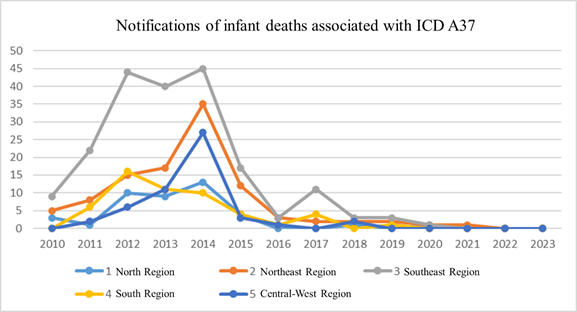
by a single ICD-10 code: A37, referring to pertussis. Considering only this
pathology, the years with the highest numbers were 2014 (130 deaths), 2012 (91)
and 2013 (88). In the years 2022 and 2023, no deaths from pertussis were
reported.
Deaths
from pertussis occurred almost entirely in the age group up to 4 years old,
representing 97.8% of total deaths, while the proportion of total cases in this
age group was 76.1%. The highest lethality occurred in 2010, with 4.56%,
followed by 2011, with 3.23%. In 2014, with the highest absolute number of
deaths, the lethality was 2.53%.
Graph 1 - Notifications
of infant deaths associated with ICD A37 (Pertussis) registered in the
Notifiable Diseases Information System (SINAN) according to regions of Brazil,
2010 to 2023
Source:
SINAN, 2025.
The findings of this study demonstrate that pertussis remains the
leading cause of infant mortality from vaccine-preventable diseases in Brazil,
even with the availability of vaccination. This result is consistent with
international literature, which discusses the “resurgence of pertussis” in
countries with high vaccination coverage. The absence of deaths in 2022 and
2023 may be related to the sanitary measures of the COVID-19 pandemic, such as
social distancing, which also apply to the prevention of pertussis. However,
the pandemic context also negatively affected vaccination coverage, which
represents a risk for future re-emergence.
Studies such as that of Medeiros et al.4 have already pointed
out that the confirmation of pertussis cases is closely related to
non-vaccination or incomplete vaccination, with children under 6 months being
the most affected. The high concentration of deaths in regions such as the
Southeast and Northeast, as observed in our data, reflects regional disparities
in the burden of vaccine-preventable diseases, as highlighted by Silva et al.5
The authors emphasize that the North and Northeast regions, despite progress,
still face higher mortality rates and lower vaccination coverage compared to
the other regions.
Other countries besides Brazil also face the challenge of a resurgence
of pertussis, such as the USA, the United Kingdom, and Australia, which,
although maintaining high vaccination coverage, have shown a considerable
increase in cases since 2010, about 30 years after achieving control of the
disease.4,6 In this context, there has been an increase in the
proportion of affected adolescents and adults, raising hypotheses about the
loss of immunogenicity over time since vaccination and possible mutations of
the etiological agent due to the selective pressure exerted by vaccination.7
Also listed as contributing factors to the lower immunogenicity of the
acellular pertussis component, used in most developed countries,6 is
the reduced targeting of vaccination efforts towards adults who have contact
with children whose vaccination schedule is still incomplete (parents,
healthcare professionals, adolescents).7 The challenge of pertussis
in countries with high vaccination coverage is multifactorial and well
documented in the literature. Factors such as the rapid decline in vaccine
efficacy (particularly of the acellular vaccine) and the change in the age
distribution of the disease are reinforced by a comprehensive systematic review
and meta-analysis on the efficacy of the pertussis vaccine.8 In
contrast, vaccination has demonstrated substantial success in relation to
varicella, with universal vaccination resulting in a marked reduction in the
incidence of the disease, hospitalizations, and pediatric mortality.9
In Brazil, most confirmed cases of pertussis still occur in children
with incomplete or absent vaccination schedules.4,6 Considering the
greater susceptibility of infants, especially those under 6 months of age,
vaccination of pregnant women with the acellular pertussis component from the
twentieth week of gestation is important in order to promote passive
immunization of newborns until they receive the first dose of the vaccine,
which has led to a reduction in the incidence of hospitalizations for pertussis
in infants under 1 year of age in Southern Brazil,10 when comparing
the period before and after the introduction of this action by the Ministry of
Health in 2014.
The resurgence of pertussis is a multifactorial phenomenon, influenced
by genetic mutations of Bordetella pertussis, by the decrease in immunity over
time after vaccination, and by improvements in surveillance and diagnostic
capacity, whose scope extends beyond national borders and is also manifested in
other countries.5,11 The results of this study reinforce the need
for continuous epidemiological surveillance and the maintenance of high
vaccination coverage to sustain disease control.
Starting in 2013, the varicella vaccine – another important cause of
vaccine-preventable deaths in Brazil – was introduced into the PNI, originally
through the tetravalent vaccine, which is administered at 15 months of age. In
2018, a second dose of varicella was also introduced at 4 years of age.
Although SINAN data for vaccine-preventable deaths do not include varicella,
the authors chose to include it in the analysis, considering its
epidemiological relevance12 and the fact that, with the introduction
of its vaccine into the PNI in 2013, it is preventable through immunization.
Since the start of varicella immunization in 2013, a reduction in deaths
from this disease has been observed. Comparing the annual average of varicella
deaths between 2010 and 2012 (105.33 deaths per year) with the annual average
between 2014 and 2016 (41.33 deaths per year), a reduction of 60.76% is
observed in this parameter. In addition to the significant drop in
varicella-related deaths after the introduction of vaccination, there was also
a decrease in hospital admission and mortality rates, especially in the 1-4
year age group, which is precisely the target group for vaccination and which
has the highest number of deaths.13 The trend of reduced mortality
and hospital admissions after the introduction of vaccination is observed not
only in Brazil, but also in other Latin American countries and territories that
have adopted the strategy of mass vaccination in the pediatric population, such
as Costa Rica and Uruguay.14
CONCLUSION
Whooping cough was the vaccine-preventable infection responsible for the
highest number of infant deaths in Brazil during the analyzed period,
associated with 68% of all notifications, as was varicella. Although varicella
is not analyzed as a vaccine-preventable disease by SINAN, it can be considered
as such from 2013 onwards, with the introduction of its vaccine as part of the
tetravalent vaccine in the PNI, corresponding to 264 deaths between 2013 and
2023, and 580 deaths between 2010 and 2023. The data reinforce the fundamental
role of childhood vaccination in reducing mortality and the urgency of
strengthening the National Immunization Program. The persistence of deaths from
whooping cough and varicella, despite the availability of vaccines, highlights
the need to improve public health strategies.
This study emphasizes the importance of action in health education, in
the active search for children with incomplete vaccination schedules, and in
the rigorous monitoring of cases, aiming at the prevention of avoidable deaths.
Future research should investigate the regional and socioeconomic barriers that
impede access to vaccination.
REFERENCES
1.
Ministério da Saúde (Brasil). Programa Nacional de
Imunizações: Calendário Nacional de Vacinação da Criança [Internet]. Brasília:
Ministério da Saúde; 2024 [acesso em 13 fev 2025]. Disponível em:
https://www.gov.br/saude/pt-br/vacinacao/calendario.
2.
Souza JFA, Silva TPR, Duarte CK, Gryschek AL de FPL,
Duarte ED, Matozinhos FP. Strategies for expanding
vaccination coverage in children in Brazil: systematic literature review. Rev
Bras Enferm. 2024;77(6):e20230343. doi: 10.1590/0034-7167-2023-0343.
3.
Sistema de Informação de Agravos de Notificação - SINAN.
Óbitos Infantis - Brasil - Notificações Registradas: banco de dados [Internet].
Brasília: DATASUS; 2025 [acesso em 14 fev 2025]. Disponível em:
http://tabnet.datasus.gov.br/cgi/tabcgi.exe?sim/cnv/inf10uf.def.
4.
Medeiros ATN, Cavalcante CAA, Souza NL, Ferreira MAF.
Reemergência da coqueluche: perfil epidemiológico dos casos confirmados. Cad
Saúde Colet. 2017;25(4):453-9. doi: 10.1590/1414-462X201700040069.
5.
Liu Y, Yu D, Wang K, Ye Q. Global resurgence of
pertussis: A perspective from China. J Infect. 2024
Nov;89(5):106289. doi: 10.1016/j.jinf.2024.106289. PMID: 39357571.
6.
Borba RCN, Vidal VM, Moreira LO. The re-emergency and
persistence of vaccine preventable diseases. An Acad Bras
Cienc. 2015;87(2 Suppl):1311-22. doi:10.1590/0001-3765201520140663.
7.
Torres RS, Santos TZ, Torres RA, Pereira VV, Fávero LA,
Filho OR, et al. Resurgence of pertussis at the age of vaccination: clinical,
epidemiological, and molecular aspects. J Pediatr (Rio J).
2015;91(4):333-8.
8.
Wilkinson K, Righolt CH, Elliott LJ, Fanella S, Mahmud
SM. Pertussis vaccine effectiveness and duration of protection - A systematic
review and meta-analysis. Vaccine. 2021 May 27;39(23):3120-3130. doi:
10.1016/j.vaccine.2021.04.032. Epub 2021 Apr 30. PMID: 33934917.
9.
Gershon AA, Gershon MD. A fresh look at varicella
vaccination. Hum Vaccin Immunother. 2025 Dec;21(1):2488099. doi:
10.1080/21645515.2025.2488099. Epub 2025 Apr 15. PMID: 40231570;
PMCID: PMC12001543.
10.
Silva SD, Friedrich F, Bitencourt LTG, Ceretta LB,
Soratto J. Hospitalização por coqueluche em crianças no período pré e pós-implantação
da vacina dTpa para gestantes. Cad Saúde Colet, 2021;29(3):344-350.
https://doi. org/10.1590/1414-462X202129030289
11.
Hu Y, Guo M, Meng Q, Yu D, Yao K. Rising pertussis cases
and deaths in China: current trends and clinical solutions. Emerg
Microbes Infect. 2024;13:2389086. doi:10.1080/22221751.2024.2389086
12.
Martino Mota A, Carvalho-Costa FA. Varicella zoster virus related deaths and hospitalizations before the
introduction of universal vaccination with the tetraviral vaccine. J
Pediatr (Rio J). 2016;92(4):361-6. doi:10.1016/j.jped.2015.10.003
13.
Ribeiro MZ, Kupek E, Ribeiro PV, Pinheiro CE. Impact of the tetra viral vaccine introduction on varicella morbidity
and mortality in the Brazilian macro regions. J Pediatr (Rio J).
2020;96(6):702-9. doi:10.1016/j.jped.2019.10.009
14.
Arlant LHF, Pirez Garcia MC, Avila Aguero ML, Cashat M,
Parellada CI, Wolfson LJ. Burden of varicella in Latin America and the
Caribbean: findings from a systematic literature review. BMC
Public Health. 2019;19:528. doi:10.1186/s12889-019-6795-0
Associate Editor:
Clemax Couto Sant Anna
ORCID: https://orcid.org/0000-0001-8732-8065
Scientific Editor:
Fernanda Pinto Mariz
ORCID: https://orcid.org/0000-0002-6981-2352
Editor:
Sociedade de Pediatria do Rio de Janeiro –
SOPERJ
E-mail: secretaria@soperj.org.br
Financial support:
None.
Availability of
research data:
The
underlying content of the research text is contained in the article.
Conflict of
interests:
None.
Authors’
contributions:
EAP Fischer:
statistical analysis, data collection, conceptualization, resource management,
project management, investigation, methodology, writing - preparation of the
original, writing - revision and editing, supervision, visualization.
LF de Souza:
statistical analysis, data collection, conceptualization, resource management,
project management, investigation, methodology, writing - preparation of the
original, writing - revision and editing, supervision, visualization.
Rev Pediatria SOPERJ 2026;26(3):
e20260385