Chart 1 - Prevalence of sex according to the region where probable dengue cases were reported from 2018 to 2024
Source: Data from SINAN.
Original Article
DOI: http://dx.doi.org/10.31365/issn.2595-1769.2026.0386
Epidemiological profile of probable dengue cases in the pediatric age group in Brazil from 2018 to 2024
Perfil epidemiológico de casos prováveis de dengue na faixa etária pediátrica no Brasil de 2018 a 2024
Perfil epidemiológico de los casos probables de dengue en la edad pediátrica en Brasil de 2018 a 2024
Tayana de Sousa Neves Viana 1,2
Camila de Araújo Simões Santos 1,3
1 Universidade Federal do Pará, Residência de Pediatria – Belém-Pará, Brasil.
2ORCID: https://orcid.org/0000-0002-3534-9056
3ORCID: https://orcid.org/0000-0002-9454-066X
Submitted: 25/08/2025
Approved: 01/10/2025
Abstract
Introduction: Dengue is a disease caused by an arbovirus of the genus Flavivirus, in the family Flaviviridae. The primary vector for this disease in Brazil is the female Aedes aegypti mosquito. Objective: To identify the epidemiological profile of probable dengue cases in the 0–19 age group from 2018 to 2024 in Brazil, as reported by the Notifiable Diseases Information System (SINAN). Methodology: A quantitative, retrospective, and descriptive study conducted using the SINAN database from 2018 to 2024. Results: There were 3,101,786 cases, 52% of which were male, with the highest number of cases in the Southeast Region (52.2%) and a predominance among those aged 15 to 19 (34.66%). The lowest number of reported cases occurred in 2020 and 2021. In 2024, the highest incidence rate was observed, accounting for 50.63% of cases, with serotype DENV-1 (70.89%) being the most common. The majority of cases (99.66%) resolved completely. Conclusion: Most reported dengue cases occurred in adolescents. There was a predominance in the Southeast region and of the DENV-1 serotype. A lower number of reported cases was observed during the SARS-CoV-2 pandemic. Most patients recovered completely, supporting the notion that dengue, in most cases, presents classic symptoms and is a self-limiting disease.
Keywords: Dengue; Health.Disease Reporting; Disease Prevention; Pediatrics.
ResumO
Introdução: A dengue é uma doença causada por um arbovírus do gênero Flavivirus, da família Flaviviridae. O principal vetor desta doença no Brasil é a fêmea do mosquito Aedes aegypti. Objetivo: Identificar o perfil epidemiológico dos casos prováveis de dengue na faixa etária de 0 a 19 anos, notificados no Brasil entre 2018 e 2024, pelo Sistema de Informação de Agravos de Notificação. Metodologia: Pesquisa quantitativa, retrospectiva e descritiva, desenvolvida com base no banco de dados de notificações no SINAN entre 2018 e 2024. Resultados: Foram 3.101.786 registros, sendo 52% do sexo masculino, com maior número de casos na Região Sudeste (52,2%) e predomínio entre 15 e 19 anos (34,66%). A menor notificação ocorreu em 2020 e 2021. O ano de 2024 foi o de maior índice, com 50,63% dos casos, sendo o sorotipo DENV-1 (70,89%) o mais frequente. A maioria dos casos (99,66%) evoluiu com resolução completa do quadro. Conclusão: A maioria das notificações de casos de dengue ocorreu entre adolescentes. Houve predomínio da região Sudeste e do sorotipo DENV-1. Observou-se um menor número de notificações nos anos da pandemia do vírus SARS-CoV-2. A maioria dos pacientes evoluiu com resolução completa do quadro, corroborando o conceito de que a dengue, em sua maioria, cursa com sintomas clássicos e é uma doença autolimitada.
Palavras-chave: Dengue; Saúde; Notificação de Doenças; Prevenção de Doenças; Pediatria.
ResumEn
Introducción: El dengue es una enfermedad causada por un arbovirus del género Flavivirus, de la familia Flaviviridae. El principal vector de esta enfermedad en Brasil es la hembra del mosquito Aedes aegypti. Objetivo: Identificar el perfil epidemiológico de los casos probables de dengue en el grupo de edad de 0 a 19 años, durante el periodo de 2018 a 2024, en Brasil, notificados por el Sistema de Información de Enfermedades de Notificación. Metodología: Estudio cuantitativo, retrospectivo y descriptivo, desarrollado a partir de la base de datos de notificaciones del SINAN entre 2018 y 2024. Resultados: Se registraron 3 101 786 casos, de los cuales el 52 % correspondía a hombres, con el mayor número de casos en la región sudeste (52,2 %) y un predominio entre los 15 y los 19 años (34,66 %). El menor número de notificaciones se registró en 2020 y 2021. El año 2024 fue el de mayor índice, con el 50,63 % de los casos, siendo el serotipo DENV-1 (70,89 %) el más frecuente. La mayoría de los casos (99,66 %) evolucionaron con resolución completa del cuadro clínico. Conclusión: La mayoría de las notificaciones de casos de dengue correspondieron a adolescentes. Hubo predominio de la región Sudeste y del serotipo DENV1. Se observó un menor número de notificaciones en los años de la pandemia por el virus SARS-CoV-2. La mayoría de los pacientes evolucionó con resolución completa del cuadro clínico, lo que corrobora el concepto de que el dengue, en su mayoría, se presenta con síntomas clásicos y es una enfermedad autolimitada.
Palabras clave: Dengue; Salud; Notificación de enfermedades; Prevención de enfermedades; Pediatría.
Dengue fever is prevalent in tropical and subtropical regions in more than 100 countries. It is a disease caused by an arbovirus of the genus Flavivirus, family Flaviviridae. The main vector of this disease in Brazil is the female Aedes aegypti mosquito, which transmits it through its bite. The virus is an RNA virus with four different serotypes: DENV-1, DENV-2, DENV-3, and DENV-4. It is characterized as a febrile illness with the highest prevalence and morbidity in Brazil, largely due to climate change, disordered urban growth without adequate infrastructure, failures in prevention, and public policies aimed at minimizing confirmed cases, which instead favor the proliferation and dissemination of the Aedes aegypti mosquito.1,2
The incubation period varies from 3 to 14 days, with an average of 5 to 6 days; the acute phase of the disease occurs in the first 5 days. Clinical manifestations range from nonspecific signs to multiple organ failure. The mild form, which occurs in most primary infections, may be asymptomatic or present with low-grade fever, myalgia, retro-orbital pain, headache, arthralgia, vomiting, and skin rashes. In the more severe cases (10%), it can progress to shock (due to increased capillary permeability) and dengue hemorrhagic fever (disseminated intravascular coagulation [DIC] and thrombocytopenia), resulting from an exacerbated immune response. The warning signs of dengue are intense abdominal pain, persistent vomiting, edema, ascites, pleural effusion, pericardial effusion, postural hypotension, hepatomegaly, mucosal bleeding, lethargy, and irritability.3
The disease can present in three phases: febrile, critical, and recovery. In the febrile phase, lasting 2 to 7 days, symptoms appear acutely, including myalgia, headache, arthralgia, adynamia, retro-orbital pain, and hyperthermia between 39 and 40 °C. In this phase, gastrointestinal symptoms such as nausea, vomiting, diarrhea, and a maculopapular rash with or without itching may be present after the febrile period. The second phase is critical, in which warning signs appear after the febrile period. Therefore, it is important to pay attention to the warning signs: intense abdominal pain, persistent vomiting, ascites, pleural effusion, pericardial effusion, postural hypotension or lipothymia, hepatomegaly more than 2 cm below the costal margin, mucosal bleeding, and lethargy and/or irritability. 3,4
Regarding the diagnosis of dengue, clinical diagnosis prevails, especially during seasonal periods in endemic areas, but because of the mimicry of other microorganisms, some tests are used for diagnosis. The RT-PCR (reverse transcription polymerase chain reaction) molecular test detects DENV RNA. In the acute phase, the first five days, the non-structural protein NS1 can be detected through immunochromatographic tests; however, a negative molecular test or NS1 result does not rule out the patient being free of infection. MAC-ELISA (IgM antibody capture enzyme immunoassay) is used for qualitative evaluation of IgM antibodies after the sixth day from the onset of symptoms, provided they remain in the bloodstream for more than 90 days; on the other hand, IgG antibodies are detected from the seventh day of symptoms in primary infection and from the first day in secondary infection. In cases of confirmed or strongly suspected dengue, therapeutic measures are recommended with symptomatic treatment, hydration, and supportive care, contraindicating the use of anti-inflammatory drugs and aspirin due to the risk of hemorrhage. A complete blood count (CBC) is a simple, readily available test in most healthcare settings. Suspected dengue cases should undergo this test. The most common changes are thrombocytopenia (50 x 109/l), most commonly between the fifth and seventh day; leukopenia (leukocytes < 4.0 x 10⁹ /l) between the fifth and sixth day; or leukocytosis with a left shift and changes in hematocrit. Other biochemical markers may be altered in dengue hemorrhagic fever, including increased lactate dehydrogenase, creatine kinase, and aspartate aminotransferase. A transient increase of serum urea and creatinine, hyponatremia, and reduced levels of albumin, cholesterol, and triglycerides may also be observed.5,6
In the current Brazilian context, vaccination is carried out using two brands made with live attenuated virus and recombinant DNA technology, both approved by the National Health Surveillance Agency (ANVISA): the Dengvaxia® vaccine (Sanofi-Pasteur), indicated only for patients with previous dengue virus infection, aged 6 to 45 years, with three doses at 6-month intervals; and the Qdenga® vaccine (Takeda Pharma), which covers the four existing serotypes, as well as seronegative and seropositive individuals within the age range of 4 to 60 years. Within the National Immunization Program (PNI), the vaccine of choice for the Unified Health System network is Qdenga®.7
Brazil became the first country to release the dengue vaccine through the public health system. Approximately 500 municipalities in 16 states were included in the campaign, targeting individuals aged 10 to 14. The Qdenga® vaccine was chosen because it covers both seronegative and seropositive individuals. Currently, a single-dose recombinant vaccine made with live attenuated virus, called Butantan-DV, is under evaluation by the Butantan Institute (São Paulo, Brazil). Studies show efficacy within 2 years among individuals aged 2 to 60 years. The increase in cases in Brazil is becoming worrying, underscoring the importance of expanding vaccination to more cities and increasing coverage among the age group.8
Interest in the topic arose from the implementation of the vaccine in the Brazilian public health network and the large number of cases reported on social networks, underscoring the importance of monitoring outcomes in the age group with the highest prevalence and administering the dengue vaccine in this public health context. However, it is essential that new research on this topic be conducted to reveal the scenario and the sociodemographic profile, along with its main predisposing factors.
The study aimed to identify the epidemiological profile of probable dengue cases in the 0-19 age group in Brazil from 2018 to 2024, as reported by the Notifiable Diseases Information System (SINAN).
METHOD
Study design
It is understood as a quantitative, retrospective, and descriptive study.
Study location
The research was developed using the Notifiable Diseases Information System (SINAN), which provides data on health problems subject to mandatory reporting and is freely accessible from various areas.
Population and sample
It covers the pediatric age range, from 0 to 19 years, both sexes, in the period from 2018 to 2024, for probable dengue cases reported in SINAN in Brazil.
Data collection
Data collection for this research was conducted according to the selected inclusion criteria for the period from 2018 to 2024, focusing on the 0-19-year age group of both sexes among probable dengue cases reported in Brazil. The data included epidemiological characteristics, age at diagnosis, diagnostic confirmation, and clinical outcome. The data obtained were tabulated and organized into tables and charts using Microsoft Excel® 2016.
Ethical aspects
The study did not require submission to the Research Ethics Committee (CEP) since the data under analysis were acquired from SINAN, a publicly accessible database, thus dispensing with the need for a commitment and data use agreement (TCUD) and a waiver of free and informed consent.
RESULTS
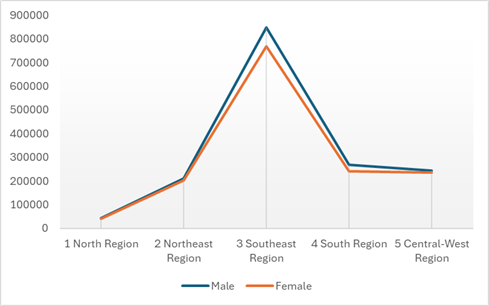
A total of 3,101,786 dengue cases were reported between 2018 and 2024 among individuals aged 0-19 years, with 52% (1,612,767) male and 48% (1,489,019) female. The highest prevalence of cases was in the Southeast Region – 52.2% (1,619,017), broken down into 848,538 males and 770,479 females – followed in descending order by the South – 16.45% (510,223), the Northeast – 13.27% (411,756), the Central-West – 15.41% (478,002), and the North – 2.67% (82,788). Males were the predominant group across all regions, but there were no significant differences (Chart 1).
Chart 1 - Prevalence of sex according to the region where probable dengue cases were reported from 2018 to 2024
Source: Data from SINAN.
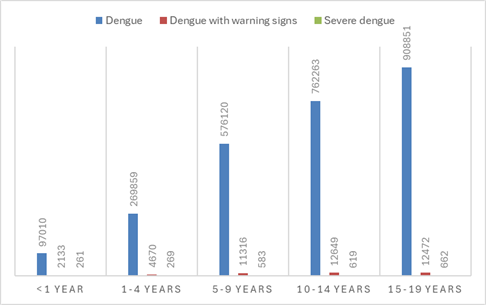
Most of the reported probable cases of dengue occurred among those aged 15-19 years –34.66% (921,985) – followed by those aged 10-14 years – 29.15% (775,531). The lowest number of reports was observed among children under one year of age. Regarding severity, 98.2% (2,614,103) of reported cases were classified as dengue (without warning signs), being the predominant form across all age groups (Chart 2).
Chart 2 - Probable cases of dengue fever by age group (0-19 years) and final classification from 2018 to 2024
Source: Data from SINAN.
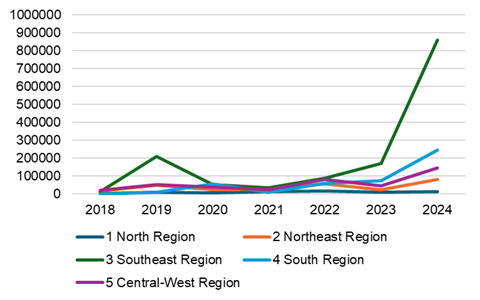
The year with the highest prevalence was 2024, with 50.63% (1,349,439) of reported cases, followed by 2019 (12.56%; 334,750), 2023 (12.22%; 325,579), and 2022 (11.47%; 305,853). Among the most significant years, the Southeast Region was the most prevalent (Chart 3).
Chart 3 - Probable cases of dengue fever by notification region according to the year of notification from 2018 to 2024
Source: Data from SINAN.
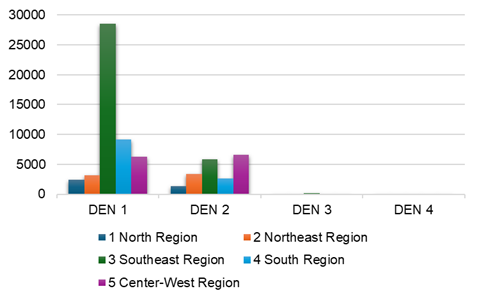
Across all regions of the country, DENV-1 was the predominant serotype, accounting for 70.89% (49,568) of cases, followed by DENV-2 at 28.45% (19,896). On the other hand, when analyzing the regions individually, it was observed that the DENV-2 serotype showed a slight predominance over DENV-1 in the Northeast (3,416 versus 3,226 cases) and Central-West (6,570 versus 6,239 cases) regions (Chart 4).
Chart 4 - Probable cases of dengue fever by reporting region according to serotype from 2018 to 2024
Source: Data from SINAN.
DISCUSSION
A study conducted in Cascavel, Paraná state, obtained a prevalence of 55.12% in males, followed by 44.84% in females, demonstrating similarity with this work. Sex is a variable that, in isolation, does not reveal a predisposition to increased vector transmissibility, as evidenced by the similarity in the data.9
Children are considered a risk group for developing dengue hemorrhagic fever or severe dengue, but the disease is mostly self-limiting, causing classic symptoms, which corroborates the study in a similar age group with a predominance of 41.8% between 10-14 years. In another study that also showed similarities in manifestations, classic dengue, with 90% of cases in this classification, indicates that, for severe evolution or hemorrhagic dengue, additional factors are needed, such as virulence, comorbidities, and the human organism's response.10,11
The prevalent age group shows a higher frequency of participation in social and school activities and other external factors, making it more vulnerable to acquiring dengue.12 A similar study showed higher notification in the Southeast Region, corroborating this research. These data may be related to the fact that this region has a larger population than other regions of the country, as well as infrastructure problems and precarious socioeconomic conditions, which may favor the spread of the vector.13,14
The reduction in reported cases from 2020 to 2021, compared with other years, may be directly related to the SARS-CoV-2 pandemic (severe acute respiratory syndrome caused by the coronavirus), which affected the number of dengue notifications.15
Other studies also confirm the higher prevalence of DENV-1 in cases of dengue without warning signs and with a favorable clinical course, and also associate it with a lower number of hospital admissions.16
The main limitations of the study are potential errors in data entry into SINAN, such as cases not included in the sample due to underreporting.
CONCLUSION
In this study, a slight predominance of males was observed among reported dengue cases. The year 2024 accounted for the highest number of reported cases, while the lowest number of reports occurred during the SARS-CoV-2 pandemic, between 2020 and 2021. The 15-19 age group was the most common among probable dengue cases. The Southeast Region had the highest number of cases, and DENV-1 was the most frequently detected serotype. Most patients presented with the classic form of the disease (dengue without warning signs) and recovered completely, supporting the concept that, in most cases, dengue presents with classic symptoms and is self-limiting.
REFERENCES
1. Mendes MS, Barbosa DBM, Brito AS. Os tipos de dengue e seus sorotipos. Revista de Trabalhos Acadêmicos Universo. Goiânia, 2022; 1(10).
2. Santos AS et al. Estratégia educativa na atenção primária à saúde para o combate ao mosquito transmissor da dengue. Seven Editora, p. 94-103; 2024.
3. Rodrigues GM, Cangirana JF. Diferenças entre dengue clássica e hemorrágica e suas respectivas medidas profiláticas. Revista Liberum Accessum. 2020; 1(1):30-38.
4. Moura-Villela EF. Sintomas, tratamento e diagnóstico: a dengue na mídia impressa durante primeira epidemia em Ribeirão Preto, São Paulo. Revista Brasileira de Pesquisa em Saúde. 2018; 20(2):121-128.
5. Medeiros EA. Desafios no controle da epidemia da dengue no Brasil. Acta Paulista de Enfermagem. 2024;37:eEDT012.
6. Santos AF. Alterações no hemograma, sintomas e tratamento. 2013. Tese de Doutorado. Instituto de Educação.
7. Oliveia CCS, et al. Vacina da dengue x sorotipo circulante: uma discussão da cobertura vacinal de acordo com a epidemiologia das regiões do Brasil. Revista JRG de Estudos Acadêmicos. 2024; 7(14):e14951-e14951.
8. Sabbi AD, et al. Dengue clássica na população pediátrica: Análise epidemiológica das internações na região Norte (2019-2023). Brazilian Journal of Implantology and Health Sciences. 2024; 6(8):2354-23565.
9. Fanton LM, Silva-Lima UT. Dengue em crianças: aspectos clínicos e epidemiológicos no município de Cascavel, Paraná, no período de 2014 a 2022. RECIMA21-Revista Científica Multidisciplinar. 2023; 4(10):e4104147-e4104147.
10. Serikava NTF; Alencar-Carvalho A, Furrier ACM. As repercussões neurológicas do vírus da DENGUE em crianças: uma análise da incidência e prognóstico em comparação com complicações cardiovasculares. Cuadernos de Educación y Desarrollo. 2024; 16(12):e6502-e6502.
11. Silva VF, et al. Perfil epidemiológico da Dengue na Região de Saúde Estrada de Ferro do Estado de Goiás, Brasil. Research, Society and Development. 2024; 13(12):e126131247650-e126131247650.
12. Monte ARCR, et al. Perfil epidemiológico das notificações de dengue na faixa etária pediátrica no Piauí no período de 2019 a 2023. Lumen et Virtus. 2024; 15(42):7045-7052.
13. Vale DBMA, et al. Avaliação de novos casos de dengue no Sudeste entre 2016 e 2024: um estudo ecológico. Brazilian Journal of Implantology and Health Sciences. 2024; 6(5):1534-1548.
14. Carraro C, et al. Perfil das internações por dengue entre as regiões brasileiras no período de 2019 a 2023. Brazilian Journal of Implantology and Health Sciences. 2024; 6(4):1217-1230.
15. Aquino Neto Gr, Freitas OCS, Silva PBO. Dengue e Covid-19: Relação entre a pandemia do SARS-COV-2 e a queda das notificações de casos de dengue no Brasil. Psych Tech & Health Journal. 2024; 7(2):20-31.
16. Correia TC, et al. Prevalência de dengue clássica e dengue hemorrágica no Brasil, entre 2011 e 2015. Revista Eletrônica Acervo Saúde. 2019; 22:e753-e753.
Associate Editor:
Clarisse Pereira Dias Drumond Fortes
ORCID:https://orcid.org/0000-0002-8253-0501:
Editor:
Sociedade de Pediatria do Rio de Janeiro – SOPERJ
E-mail: secretaria@soperj.org.br
Financial support:
None.
Availability of research data:
The underlying data are contained in the article.
Conflict of interests:
None.
Authors’ contributions:
TSN Viana: statistical analysis, fundraising, data collection, conceptualization, resource management, project management, research, methodology, drafting - original preparation, drafting - revision and editing, software, validation, and visualization.
CAS Santos: project management, drafting - revision and editing, supervision, visualization.
 Rev Pediatria SOPERJ 2026;26(2):
e20260386
Rev Pediatria SOPERJ 2026;26(2):
e20260386